JUDAISM (Waiting)
True Jesus but rejected and crucified – As per the scriptures Isaiah 53
 KJT ☦Knowing Jesus Today
Discerning · History & Meaning
“The Christian ideal has not been tried and found wanting. It has been found difficult; and left untried.”
A record worth remembering
Jesus, the Cross & the record of Scripture
01 / History
The original page opens with the life of Jesus, His final words on the Cross, His place in history, and the people and events remembered around Him.
Don’t reset your history.
You won’t know yourself any longer.
There’s no doubt that Jesus existed. Many Christian and non Christian sources have mentioned Jesus or His Life. The historicity of Jesus is almost impossible to dispute.
Jesus Christ (The man) was born a little over 2 millennia ago in the town of Bethlehem, ancient Palestine, Canaan. He was of a miraculous birth from a Virgin named Mary, she was about to be betrothed to a man named Joseph. Both Mary and Joseph are of the line of King David. The Bible follows both Jewish and non Jewish tradition to detail the blood line of Jesus. This was a fulfillment of a prophecy where Jesus Christ would be from the Line of David.
Jesus grew up in the town of Nazareth and that’s why He was also called Jesus of Nazareth or the Nazarene. He performed many miracles both great and small. He was blameless, yet He was crucified, died and rose on the 3rd day. As per both scripture and documented historical witnesses. Then He rose to sit on the right hand of the Father in Heaven. Amen.
Jesus Christ (God) is the Word of God. He Is. He is eternal and He is the creator of all. Everything is by Him, through Him and for Him.
“1 In the beginning was the Word, and the Word was with God, and the Word was God. 2 He was in the beginning with God. 3 All things were made through Him, and without Him nothing was made that was made. 4 In Him was life, and the life was the light of men. 5 And the light shines in the darkness, and the darkness did not comprehend it.”
Jesus is also the Good Shepherd
“11 I am the good shepherd. The good shepherd gives His life for the sheep. 12 But a hireling, he who is not the shepherd, one who does not own the sheep, sees the wolf coming and leaves the sheep and flees; and the wolf catches the sheep and scatters them.”
Jesus Christ – Celebrated by everyone
Whether they know it or not, the entire whole world, is counting the years since 00 AD or ADNJC to be exact Anno Domini Nostri Jesu Christi (The Year of our Lord Jesus Christ) – Make sure you don’t go along with the change of calendar they want in order to satisfy their ego.
Don’t reset your history.
You won’t know yourself any longer.
Jesus Christ made seven last statements while on the Cross
These reveal both His Divinity and Human Side.
“Father, forgive them, for they know not what they do.”
“Today shalt thou be with Me in paradise.”
“Woman, behold thy Son.”
“My God, my God, why hast Thou forsaken Me?”
“I thirst.”
“It is finished.”
“Father, into Thy hands I commend My spirit.”
| Saying | Matthew | Mark | Luke | John |
|---|---|---|---|---|
| Father, forgive them; for they know not what they do. | — | — | 23:34 | — |
| Verily I say unto thee, To day shalt thou be with me in paradise. | — | — | 23:43 | — |
| Woman, behold thy son! and Behold thy mother! | — | — | — | 19:26–27 |
| My God, my God, why hast thou forsaken me? | 27:46 | 15:34 | — | — |
| I thirst. | — | — | — | 19:28 |
| It is finished. | — | — | — | 19:30 |
| Father, into thy hands I commend my spirit. | — | — | 23:46 | — |
All Major Religions Know the Name Jesus but not all of them know the real Jesus Christ of Nazareth, born of a Virgin, died on the cross and rose again on the 3rd day; As per the Scriptures.
True Jesus but rejected and crucified – As per the scriptures Isaiah 53
Jesus from hearsay and local cultural legends. Islam claims that it is the continuation of the biblical narrative, it uses Jesus and other biblical people (prophets) as reference but with an Islamic version. Jesus is mentioned more than anyone else in the Quran and Muslims expect Jesus to return for a final battle against an antichrist figure. After defeating him, Jesus would judge the world. Quran states that Jesus is the word (Sura 3 (Al Imran) 3:39, 3:34) and spirit from God (Sura 4 (Al Nisa) 4:171); but for some reason falls short in making the connection that He is God. (The Bible says that He who judges the world is God Almighty)
Jesus from hearsay and local cultural legends. Some Hindus believe that Jesus was a good man and moved to India where he got married and had children.
Regardless of how he is seen, this is one example showing some form of knowledge of a Jesus Christ. Even within non Abrahamic religions.
Christian statement of belief focused on Trinitarian doctrine and Christology
According to Orthodoxwiki; The Athanasian Creed (Quicunque vult) is a statement of Christian doctrine traditionally ascribed to St. Athanasius, Archbishop of Alexandria, who lived in the 4th century. Some of today’s historians believe that it was originally written in Latin, not in Greek, and thus Athanasius cannot have been the original author. There are those that believe its theology is closely akin to that found in the writing of western theologians, especially Ambrose of Milan.
It was designed to overcome Arianism. Liturgically, this Creed was recited at the Sunday Office of Prime in the Western Church; it is not in common use in the Eastern Church. Today the Athanasian Creed is rarely used even in the Western Church. When used, one common practice is to use it once a year on Trinity Sunday.
The Creed · (1-44 omitted for brevity)
Dinosaurs were recorded in the Bible
Behemoth (Land Dino) (Job 40:15-24): Behold now behemoth, which I made with thee; he eateth grass as an ox...
Leviathan (sea Dino): Job 41:1· Psalms 74:14· Psalms 104:26· Isaiah 27:1
Most important date in the calendar. Most important event in Christianity.
Throughout history, there have been people that were brought back from the dead (resurrected). This is was both before and during the time of Christ. We have counted eight in total, Christ being the 9th:
In Aramaic, Hebrew and Arabic the first day of the week is actually Sunday. Aramaic Yom Had (Day 1), Hebrew Yom Reshon (Day One) and Arabic: Yom Al Ahad (Day One) complying with the biblical narrative.
More history topics
History - Holy Friday
History - Lazarus Saturday
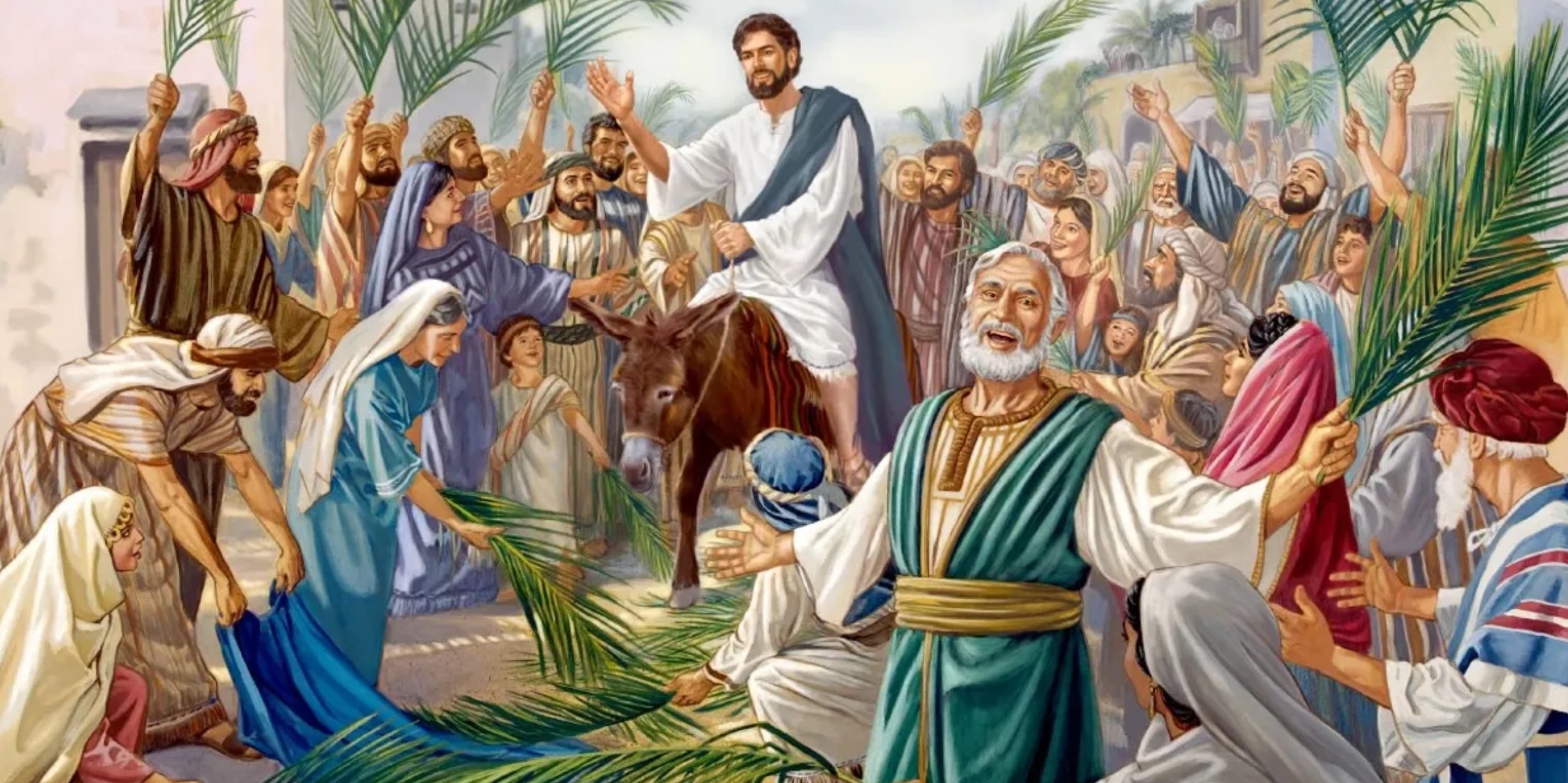
History - Palm Sunday
Peace Be : Common Greeting in Ancient Palestine
02 / Geography
The source page gathers the places that carry the history of the biblical narrative.
It is also the name of the country of which this city was the capital, namely, northern or upper Babylonia. The Accadians who came from the “mountains of the east,” where the ark rested, attained to a high degree of civilization. In the Babylonian inscriptions they are called “the black heads” and “the black faces,” in contrast to “the white race” of Semitic descent. They invented the form of writing in pictorial hieroglyphics, and also the cuneiform system, in which they wrote many books partly on papyrus and partly on clay. The Semitic Babylonians (“the white race”), or, as some scholars think, first the Cushites, and afterwards, as a second immigration, the Semites, invaded and conquered this country; and then the Accadian language ceased to be a spoken language, although for the sake of its literary treasures it continued to be studied by the educated classes of Babylonia. A large portion of the Ninevite tablets brought to light by Oriental research consists of interlinear or parallel translations from Accadian into Assyrian; and thus that long-forgotten language has been recovered by scholars. It belongs to the class of languages called agglutinative, common to the Tauranian race; i.e., it consists of words “glued together,” without declension of conjugation. These tablets in a remarkable manner illustrate ancient history. Among other notable records, they contain an account of the Creation which closely resembles that given in the book of Genesis, of the Sabbath as a day of rest, and of the Deluge and its cause. (See BABYLON; CHALDEA.)
The Greek form of BABEL; Semitic form Babilu, meaning “The Gate of God.” In the Assyrian tablets it means “The city of the dispersion of the tribes.” The monumental list of its kings reaches back to B.C. 2300, and includes Khammurabi, or Amraphel (q.v.), the contemporary of Abraham. It stood on the Euphrates, about 200 miles above its junction with the Tigris, which flowed through its midst and divided it into two almost equal parts. The Elamites invaded Chaldea (i.e., Lower Mesopotamia, or Shinar, and Upper Mesopotamia, or Accad, now combined into one) and held it in subjection. At length Khammu-rabi delivered it from the foreign yoke, and founded the new empire of Chaldea (q.v.), making Babylon the capital of the united kingdom. This city gradually grew in extent and grandeur, but in process of time it became subject to Assyria. On the fall of Nineveh (B.C. 606) it threw off the Assyrian yoke, and became the capital of the growing Babylonian empire. Under Nebuchadnezzar it became one of the most splendid cities of the ancient world.
After passing through various vicissitudes the city was occupied by Cyrus, “king of Elam,” B.C. 538, who issued a decree permitting the Jews to return to their own land (Ezra 1). It then ceased to be the capital of an empire. It was again and again visited by hostile armies, till its inhabitants were all driven from their homes, and the city became a complete desolation, its very site being forgotten from among men.
On the west bank of the Euphrates, about 50 miles south of Bagdad, there is found a series of artificial mounds of vast extent. These are the ruins of this once famous proud city. These ruins are principally (1) the great mound called Babil by the Arabs. This was probably the noted Temple of Belus, which was a pyramid about 480 feet high. (2) The Kasr (i.e., “the palace”). This was the great palace of Nebuchadnezzar. It is almost a square, each side of which is about 700 feet long. The little town of Hillah, near the site of Babylon, is built almost wholly of bricks taken from this single mound. (3) A lofty mound, on the summit of which stands a modern tomb called Amran ibn-Ali. This is probably the most ancient portion of the remains of the city, and represents the ruins of the famous hanging-gardens, or perhaps of some royal palace. The utter desolation of the city once called “The glory of kingdoms” (Isa.13:19) was foretold by the prophets (Isa.13:4-22; Jer. 25:12; 50:2, 3; Dan. 2:31-38).
The Babylon mentioned in 1 Pet. 5:13 was not Rome, as some have thought, but the literal city of Babylon, which was inhabited by many Jews at the time Peter wrote.
In Rev. 14:8; 16:19; 17:5; and 18:2, “Babylon” is supposed to mean Rome, not considered as pagan, but as the prolongation of the ancient power in the papal form. Rome, pagan and papal, is regarded as one power. “The literal Babylon was the beginner and supporter of tyranny and idolatry…This city and its whole empire were taken by the Persians under Cyrus; the Persians were subdued by the Macedonians, and the Macedonians by the Romans; so that Rome succeeded to the power of old Babylon. And it was her method to adopt the worship of the false deities she had conquered; so that by her own act she became the heiress and successor of all the Babylonian idolatry, and of all that was introduced into it by the immediate successors of Babylon, and consequently of all the idolatry of the earth.” Rome, or “mystical Babylon,” is “that great city which reigneth over the kings of the earth” (17:18).
Literally: House of Bread
[*Easton*]House of bread. (1.) A city in the “hill country” of Judah. It was originally called Ephrath (Gen. 35:16, 19; 48:7; Ruth 4:11). It was also called Beth-lehem Ephratah (Micah 5:2), Beth-lehem-judah (1 Sam. 17:12), and “the city of David” (Luke 2:4). It is first noticed in Scripture as the place where Rachel died and was buried “by the wayside,” directly to the north of the city (Gen. 48:7). The valley to the east was the scene of the story of Ruth the Moabitess. There are the fields in which she gleaned, and the path by which she and Naomi returned to the town. Here was David’s birth-place, and here also, in after years, he was anointed as king by Samuel (1 Sam. 16:4-13); and it was from the well of Bethlehem that three of his heroes brought water for him at the risk of their lives when he was in the cave of Adullam (2 Sam. 23:13-17). But it was distinguished above every other city as the birth-place of “Him whose goings forth have been of old” (Matt. 2:6; comp. Micah 5:2). Afterwards Herod, “when he saw that he was mocked of the wise men,” sent and slew “all the children that were in Bethlehem, and in all the coasts thereof, from two years old and under” (Matt. 2:16, 18; Jer. 31:15).Bethlehem bears the modern name of Beit-Lahm, i.e., “house of flesh.” It is about 5 miles south of Jerusalem, standing at an elevation of about 2,550 feet above the sea, thus 100 feet higher than Jerusalem.
There is a church still existing, built by Constantine the Great (A.D. 330), called the “Church of the Nativity,” over a grotto or cave called the “holy crypt,” and said to be the “stable” in which Jesus was born. This is perhaps the oldest existing Christian church in the world. Close to it is another grotto, where Jerome the Latin father is said to have spent thirty years of his life in translating the Scriptures into Latin. (See VERSION.)
(2.) A city of Zebulun, mentioned only in Josh. 19:15. Now Beit-Lahm, a ruined village about 6 miles west-north-west of Nazareth.
Some have argued from 2 Cor. 12:14; 13:1, that Paul visited Corinth a third time (i.e., that on some unrecorded occasion he visited the city between what are usually called the first and second visits). But the passages referred to only indicate Paul’s intention to visit Corinth (comp. 1 Cor. 16:5, where the Greek present tense denotes an intention), an intention which was in some way frustrated. We can hardly suppose that such a visit could have been made by the apostle without more distinct reference to it.
Many Jews took up their residence in this city, and here the seeds of the gospel were sown immediately after Pentecost (Acts 2:9; 6:9). At the close of his second missionary journey (about A.D. 51), when Paul was returning from Greece to Syria (18:18-21), he first visited this city. He remained, however, for only a short time, as he was hastening to keep the feast, probably of Pentecost, at Jerusalem; but he left Aquila and Priscilla behind him to carry on the work of spreading the gospel.
During his third missionary journey Paul reached Ephesus from the “upper coasts” (Acts 19:1), i.e., from the inland parts of Asia Minor, and tarried here for about three years; and so successful and abundant were his labours that “all they which dwelt in Asia heard the word of the Lord Jesus, both Jews and Greeks” (19:10). Probably during this period the seven churches of the Apocalypse were founded, not by Paul’s personal labours, but by missionaries whom he may have sent out from Ephesus, and by the influence of converts returning to their homes.
On his return from his journey, Paul touched at Miletus, some 30 miles south of Ephesus (Acts 20:15), and sending for the presbyters of Ephesus to meet him there, he delivered to them that touching farewell charge which is recorded in Acts 20:18-35. Ephesus is not again mentioned till near the close of Paul’s life, when he writes to Timothy exhorting him to “abide still at Ephesus” (1 Tim. 1:3).
Two of Paul’s companions, Trophimus and Tychicus, were probably natives of Ephesus (Acts 20:4; 21:29; 2 Tim. 4:12). In his second epistle to Timothy, Paul speaks of Onesiphorus as having served him in many things at Ephesus (2 Tim. 1:18). He also “sent Tychicus to Ephesus” (4:12), probably to attend to the interests of the church there. Ephesus is twice mentioned in the Apocalypse (1:11; 2:1).
The apostle John, according to tradition, spent many years in Ephesus, where he died and was buried.
A part of the site of this once famous city is now occupied by a small Turkish village, Ayasaluk, which is regarded as a corruption of the two Greek words, hagios theologos; i.e., “the holy divine.”
God’s Holy City
[*Easton*]
Called also Salem, Ariel, Jebus, the “city of God,” the “holy city;” by the modern Arabs el-Khuds, meaning “the holy;” once “the city of Judah” (2 Chr. 25:28). This name is in the original in the dual form, and means “possession of peace,” or “foundation of peace.” The dual form probably refers to the two mountains on which it was built, viz., Zion and Moriah; or, as some suppose, to the two parts of the city, the “upper” and the “lower city.” Jerusalem is a “mountain city enthroned on a mountain fastness” (comp. Ps. 68:15, 16; 87:1; 125:2; 76:1, 2; 122:3). It stands on the edge of one of the highest table-lands in Palestine, and is surrounded on the south-eastern, the southern, and the western sides by deep and precipitous ravines.
It is first mentioned in Scripture under the name Salem (Gen. 14:18; comp. Ps. 76:2). When first mentioned under the name Jerusalem, Adonizedek was its king (Josh. 10:1). It is afterwards named among the cities of Benjamin (Judg. 19:10; 1 Chr. 11:4); but in the time of David it was divided between Benjamin and Judah. After the death of Joshua the city was taken and set on fire by the men of Judah (Judg. 1:1-8); but the Jebusites were not wholly driven out of it. The city is not again mentioned till we are told that David brought the head of Goliath thither (1 Sam. 17:54). David afterwards led his forces against the Jebusites still residing within its walls, and drove them out, fixing his own dwelling on Zion, which he called “the city of David” (2 Sam. 5:5-9; 1 Chr. 11:4-8). Here he built an altar to the Lord on the threshing-floor of Araunah the Jebusite (2 Sam. 24:15-25), and thither he brought up the ark of the covenant and placed it in the new tabernacle which he had prepared for it. Jerusalem now became the capital of the kingdom.
After the death of David, Solomon built the temple, a house for the name of the Lord, on Mount Moriah (B.C. 1010). He also greatly strengthened and adorned the city, and it became the great centre of all the civil and religious affairs of the nation (Deut. 12:5; comp. 12:14; 14:23; 16:11-16; Ps. 122).
After the disruption of the kingdom on the accession to the throne of Rehoboam, the son of Solomon, Jerusalem became the capital of the kingdom of the two tribes. It was subsequently often taken and retaken by the Egyptians, the Assyrians, and by the kings of Israel (2 Kings 14:13, 14; 18:15, 16; 23:33-35; 24:14; 2 Chr. 12:9; 26:9; 27:3, 4; 29:3; 32:30; 33:11), till finally, for the abounding iniquities of the nation, after a siege of three years, it was taken and utterly destroyed, its walls razed to the ground, and its temple and palaces consumed by fire, by Nebuchadnezzar, the king of Babylon (2 Kings 25; 2 Chr. 36; Jer. 39), B.C. 588. The desolation of the city and the land was completed by the retreat of the principal Jews into Egypt (Jer. 40-44), and by the final carrying captive into Babylon of all that still remained in the land (52:3), so that it was left without an inhabitant (B.C. 582). Compare the predictions, Deut. 28; Lev. 26:14-39.
But the streets and walls of Jerusalem were again to be built, in troublous times (Dan. 9:16, 19, 25), after a captivity of seventy years. This restoration was begun B.C. 536, “in the first year of Cyrus” (Ezra 1:2, 3, 5-11). The Books of Ezra and Nehemiah contain the history of the re-building of the city and temple, and the restoration of the kingdom of the Jews, consisting of a portion of all the tribes. The kingdom thus constituted was for two centuries under the dominion of Persia, till B.C. 331; and thereafter, for about a century and a half, under the rulers of the Greek empire in Asia, till B.C. 167. For a century the Jews maintained their independence under native rulers, the Asmonean princes. At the close of this period they fell under the rule of Herod and of members of his family, but practically under Rome, till the time of the destruction of Jerusalem, A.D. 70. The city was then laid in ruins.
The modern Jerusalem by-and-by began to be built over the immense beds of rubbish resulting from the overthrow of the ancient city; and whilst it occupies certainly the same site, there are no evidences that even the lines of its streets are now what they were in the ancient city. Till A.D. 131 the Jews who still lingered about Jerusalem quietly submitted to the Roman sway. But in that year the emperor (Hadrian), in order to hold them in subjection, rebuilt and fortified the city. The Jews, however, took possession of it, having risen under the leadership of one Bar-Chohaba (i.e., “the son of the star”) in revolt against the Romans. Some four years afterwards (A.D. 135), however, they were driven out of it with great slaughter, and the city was again destroyed; and over its ruins was built a Roman city called Aelia Capitolina, a name which it retained till it fell under the dominion of the Mohammedans, when it was called el-Khuds, i.e., “the holy.”
In A.D. 326 Helena, mother of the emperor Constantine, made a pilgrimage to Jerusalem with the view of discovering the places mentioned in the life of our Lord. She caused a church to be built on what was then supposed to be the place of the nativity at Bethlehem. Constantine, animated by her example, searched for the holy sepulchre, and built over the supposed site a magnificent church, which was completed and dedicated A.D. 335. He relaxed the laws against the Jews till this time in force, and permitted them once a year to visit the city and wail over the desolation of “the holy and beautiful house.”
In A.D. 614 the Persians, after defeating the Roman forces of the emperor Heraclius, took Jerusalem by storm, and retained it till A.D. 637, when it was taken by the Arabians under the Khalif Omar. It remained in their possession till it passed, in A.D. 960, under the dominion of the Fatimite khalifs of Egypt, and in A.D. 1073 under the Turcomans. In A.D. 1099 the crusader Godfrey of Bouillon took the city from the Moslems with great slaughter, and was elected king of Jerusalem. He converted the Mosque of Omar into a Christian cathedral. During the eighty-eight years which followed, many churches and convents were erected in the holy city. The Church of the Holy Sepulchre was rebuilt during this period, and it alone remains to this day. In A.D. 1187 the sultan Saladin wrested the city from the Christians. From that time to the present day, with few intervals, Jerusalem has remained in the hands of the Moslems. It has, however, during that period been again and again taken and retaken, demolished in great part and rebuilt, no city in the world having passed through so many vicissitudes.
In the year 1850 the Greek and Latin monks residing in Jerusalem had a fierce dispute about the guardianship of what are called the “holy places.” In this dispute the emperor Nicholas of Russia sided with the Greeks, and Louis Napoleon, the emperor of the French, with the Latins. This led the Turkish authorities to settle the question in a way unsatisfactory to Russia. Out of this there sprang the Crimean War, which was protracted and sanguinary, but which had important consequences in the way of breaking down the barriers of Turkish exclusiveness.
Modern Jerusalem “lies near the summit of a broad mountain-ridge, which extends without interruption from the plain of Esdraelon to a line drawn between the southern end of the Dead Sea and the southeastern corner of the Mediterranean.” This high, uneven table-land is everywhere from 20 to 25 geographical miles in breadth. It was anciently known as the mountains of Ephraim and Judah.
“Jerusalem is a city of contrasts, and differs widely from Damascus, not merely because it is a stone town in mountains, whilst the latter is a mud city in a plain, but because while in Damascus Moslem religion and Oriental custom are unmixed with any foreign element, in Jerusalem every form of religion, every nationality of East and West, is represented at one time.”
Jerusalem is first mentioned under that name in the Book of Joshua, and the Tell-el-Amarna collection of tablets includes six letters from its Amorite king to Egypt, recording the attack of the Abiri about B.C. 1480. The name is there spelt Uru-Salim (“city of peace”). Another monumental record in which the Holy City is named is that of Sennacherib’s attack in B.C. 702. The “camp of the Assyrians” was still shown about A.D. 70, on the flat ground to the north-west, included in the new quarter of the city.
The city of David included both the upper city and Millo, and was surrounded by a wall built by David and Solomon, who appear to have restored the original Jebusite fortifications. The name Zion (or Sion) appears to have been, like Ariel (“the hearth of God”), a poetical term for Jerusalem, but in the Greek age was more specially used of the Temple hill. The priests’ quarter grew up on Ophel, south of the Temple, where also was Solomon’s Palace outside the original city of David. The walls of the city were extended by Jotham and Manasseh to include this suburb and the Temple (2 Chr. 27:3; 33:14).
Jerusalem is now a town of some 50,000 inhabitants, with ancient mediaeval walls, partly on the old lines, but extending less far to the south. The traditional sites, as a rule, were first shown in the 4th and later centuries A.D., and have no authority. The results of excavation have, however, settled most of the disputed questions, the limits of the Temple area, and the course of the old walls having been traced.
Jordan
Heb. Yarden, “the descender;” Arab. Nahr-esh-Sheriah, “the watering-place” the chief river of Palestine. It flows from north to south down a deep valley in the centre of the country. The name descender is significant of the fact that there is along its whole course a descent to its banks; or it may simply denote the rapidity with which it “descends” to the Dead Sea.
It originates in the snows of Hermon, which feed its perennial fountains. Two sources are generally spoken of. (1.) From the western base of a hill on which once stood the city of Dan, the northern border-city of Palestine, there gushes forth a considerable fountain called the Leddan, which is the largest fountain in Syria and the principal source of the Jordan. (2.) Beside the ruins of Banias, the ancient Caesarea Philippi and the yet more ancient Panium, is a lofty cliff of limestone, at the base of which is a fountain. This is the other source of the Jordan, and has always been regarded by the Jews as its true source. It rushes down to the plain in a foaming torrent, and joins the Leddan about 5 miles south of Dan (Tell-el-Kady). (3.) But besides these two historical fountains there is a third, called the Hasbany, which rises in the bottom of a valley at the western base of Hermon, 12 miles north of Tell-el-Kady. It joins the main stream about a mile below the junction of the Leddan and the Banias. The river thus formed is at this point about 45 feet wide, and flows in a channel from 12 to 20 feet below the plain. After this it flows, “with a swift current and a much-twisted course,” through a marshy plain for some 6 miles, when it falls into the Lake Huleh, “the waters of Merom” (q.v.).
During this part of its course the Jordan has descended about 1,100 feet. At Banias it is 1,080 feet above sea-level. Flowing from the southern extremity of Lake Huleh, here almost on a level with the sea, it flows for 2 miles “through a waste of islets and papyrus,” and then for 9 miles through a narrow gorge in a foaming torrent onward to the Sea of Galilee (q.v.).
“In the whole valley of the Jordan from the Lake Huleh to the Sea of Galilee there is not a single settled inhabitant. Along the whole eastern bank of the river and the lakes, from the base of Hermon to the ravine of Hieromax, a region of great fertility, 30 miles long by 7 or 8 wide, there are only some three inhabited villages. The western bank is almost as desolate. Ruins are numerous enough. Every mile or two is an old site of town or village, now well nigh hid beneath a dense jungle of thorns and thistles. The words of Scripture here recur to us with peculiar force: ‘I will make your cities waste, and bring your sanctuaries unto desolation…And I will bring the land into desolation: and your enemies which dwell therein shall be astonished at it…And your land shall be desolate, and your cities waste. Then shall the land enjoy her sabbaths, as long as it lieth desolate’ (Lev. 26:31-34).”, Dr. Porter’s Handbook.
From the Sea of Galilee, at the level of 682 feet below the Mediterranean, the river flows through a long, low plain called “the region of Jordan” (Matt. 3:5), and by the modern Arabs the Ghor, or “sunken plain.” This section is properly the Jordan of Scripture. Down through the midst of the “plain of Jordan” there winds a ravine varying in breadth from 200 yards to half a mile, and in depth from 40 to 150 feet. Through it the Jordan flows in a rapid, rugged, tortuous course down to the Dead Sea. The whole distance from the southern extremity of the Sea of Galilee to the Dead Sea is in a straight line about 65 miles, but following the windings of the river about 200 miles, during which it falls 618 feet. The total length of the Jordan from Banias is about 104 miles in a straight line, during which it falls 2,380 feet.
There are two considerable affluents which enter the river between the Sea of Galilee and the Dead Sea, both from the east. (1.) The Wady Mandhur, called the Yarmuk by the Rabbins and the Hieromax by the Greeks. It formed the boundary between Bashan and Gilead. It drains the plateau of the Hauran. (2.) The Jabbok or Wady Zerka, formerly the northern boundary of Ammon. It enters the Jordan about 20 miles north of Jericho.
The first historical notice of the Jordan is in the account of the separation of Abraham and Lot (Gen. 13:10). “Lot beheld the plain of Jordan as the garden of the Lord.” Jacob crossed and recrossed “this Jordan” (32:10). The Israelites passed over it as “on dry ground” (Josh. 3:17; Ps. 114:3). Twice afterwards its waters were miraculously divided at the same spot by Elijah and Elisha (2 Kings 2:8, 14).
The Jordan is mentioned in the Old Testament about one hundred and eighty times, and in the New Testament fifteen times. The chief events in gospel history connected with it are (1) John the Baptist’s ministry, when “there went out to him Jerusalem, and all Judaea, and were baptized of him in Jordan” (Matt. 3:6). (2.) Jesus also “was baptized of John in Jordan” (Mark 1:9).
This “exceeding great city” lay on the eastern or left bank of the river Tigris, along which it stretched for some 30 miles, having an average breadth of 10 miles or more from the river back toward the eastern hills. This whole extensive space is now one immense area of ruins. Occupying a central position on the great highway between the Mediterranean and the Indian Ocean, thus uniting the East and the West, wealth flowed into it from many sources, so that it became the greatest of all ancient cities.
About B.C. 633 the Assyrian empire began to show signs of weakness, and Nineveh was attacked by the Medes, who subsequently, about B.C. 625, being joined by the Babylonians and Susianians, again attacked it, when it fell, and was razed to the ground. The Assyrian empire then came to an end, the Medes and Babylonians dividing its provinces between them. “After having ruled for more than six hundred years with hideous tyranny and violence, from the Caucasus and the Caspian to the Persian Gulf, and from beyond the Tigris to Asia Minor and Egypt, it vanished like a dream” (Nah. 2:6-11). Its end was strange, sudden, tragic. It was God’s doing, his judgement on Assyria’s pride (Isa. 10:5-19).
Forty years ago our knowledge of the great Assyrian empire and of its magnificent capital was almost wholly a blank. Vague memories had indeed survived of its power and greatness, but very little was definitely known about it. Other cities which had perished, as Palmyra, Persepolis, and Thebes, had left ruins to mark their sites and tell of their former greatness; but of this city, imperial Nineveh, not a single vestige seemed to remain, and the very place on which it had stood was only matter of conjecture. In fulfilment of prophecy, God made “an utter end of the place.” It became a “desolation.”
In the days of the Greek historian Herodotus, B.C. 400, it had become a thing of the past; and when Xenophon the historian passed the place in the “Retreat of the Ten Thousand,” the very memory of its name had been lost. It was buried out of sight, and no one knew its grave. It is never again to rise from its ruins.
At length, after being lost for more than two thousand years, the city was disentombed. A little more than forty years ago the French consul at Mosul began to search the vast mounds that lay along the opposite bank of the river. The Arabs whom he employed in these excavations, to their great surprise, came upon the ruins of a building at the mound of Khorsabad, which, on further exploration, turned out to be the royal palace of Sargon, one of the Assyrian kings. They found their way into its extensive courts and chambers, and brought forth form its hidded depths many wonderful sculptures and other relics of those ancient times.
The work of exploration has been carried on almost continuously by M. Botta, Sir Henry Layard, George Smith, and others, in the mounds of Nebi-Yunus, Nimrud, Koyunjik, and Khorsabad, and a vast treasury of specimens of old Assyrian art has been exhumed. Palace after palace has been discovered, with their decorations and their sculptured slabs, revealing the life and manners of this ancient people, their arts of war and peace, the forms of their religion, the style of their architecture, and the magnificence of their monarchs. The streets of the city have been explored, the inscriptions on the bricks and tablets and sculptured figures have been read, and now the secrets of their history have been brought to light.
One of the most remarkable of recent discoveries is that of the library of King Assur-bani-pal, or, as the Greek historians call him, Sardanapalos, the grandson of Sennacherib (q.v.). (See ASNAPPER.) This library consists of about ten thousand flat bricks or tablets, all written over with Assyrian characters. They contain a record of the history, the laws, and the religion of Assyria, of the greatest value. These strange clay leaves found in the royal library form the most valuable of all the treasuries of the literature of the old world. The library contains also old Accadian documents, which are the oldest extant documents in the world, dating as far back as probably about the time of Abraham. (See SARGON.)
“The Assyrian royalty is, perhaps, the most luxurious of our century [reign of Assur-bani-pa]…Its victories and conquests, uninterrupted for one hundred years, have enriched it with the spoil of twenty peoples. Sargon has taken what remained to the Hittites; Sennacherib overcame Chaldea, and the treasures of Babylon were transferred to his coffers; Esarhaddon and Assur-bani-pal himself have pillaged Egypt and her great cities, Sais, Memphis, and Thebes of the hundred gates…Now foreign merchants flock into Nineveh, bringing with them the most valuable productions from all countries, gold and perfume from South Arabia and the Chaldean Sea, Egyptian linen and glass-work, carved enamels, goldsmiths’ work, tin, silver, Phoenician purple; cedar wood from Lebanon, unassailable by worms; furs and iron from Asia Minor and Armenia” (Ancient Egypt and Assyria, by G. Maspero, page 271).
The bas-reliefs, alabaster slabs, and sculptured monuments found in these recovered palaces serve in a remarkable manner to confirm the Old Testament history of the kings of Israel. The appearance of the ruins shows that the destruction of the city was due not only to the assailing foe but also to the flood and the fire, thus confirming the ancient prophecies concerning it. “The recent excavations,” says Rawlinson, “have shown that fire was a great instrument in the destruction of the Nineveh palaces. Calcined alabaster, charred wood, and charcoal, colossal statues split through with heat, are met with in parts of the Nineveh mounds, and attest the veracity of prophecy.”
Nineveh in its glory was (Jonah 3:4) an “exceeding great city of three days’ journey”, i.e., probably in circuit. This would give a circumference of about 60 miles. At the four corners of an irregular quadrangle are the ruins of Kouyunjik, Nimrud, Karamless and Khorsabad. These four great masses of ruins, with the whole area included within the parallelogram they form by lines drawn from the one to the other, are generally regarded as composing the whole ruins of Nineveh.
First appearance in Exodus 15:14: The people shall hear, and be afraid: sorrow shall take hold on the inhabitants of Palestina.
Easton’s Bible Dictionary
Originally denoted only the sea-coast of the land of Canaan inhabited by the Philistines (Ex. 15:14; Isa. 14:29, 31; Joel 3:4), and in this sense exclusively the Hebrew name Pelesheth (rendered “Philistia” in Ps. 60:8; 83:7; 87:4; 108:9) occurs in the Old Testament.
Not till a late period in Jewish history was this name used to denote “the land of the Hebrews” in general (Gen. 40:15). It is also called “the holy land” (Zech. 2:12), the “land of Jehovah” (Hos. 9:3; Ps. 85:1), the “land of promise” (Heb. 11:9), because promised to Abraham (Gen. 12:7; 24:7), the “land of Canaan” (Gen. 12:5), the “land of Israel” (1 Sam. 13:19), and the “land of Judah” (Isa. 19:17).
The territory promised as an inheritance to the seed of Abraham (Gen. 15:18-21; Num. 34:1-12) was bounded on the east by the river Euphrates, on the west by the Mediterranean, on the north by the “entrance of Hamath,” and on the south by the “river of Egypt.” This extent of territory, about 60,000 square miles, was at length conquered by David, and was ruled over also by his son Solomon (2 Sam. 8; 1 Chr. 18; 1 Kings 4:1, 21). This vast empire was the Promised Land; but Palestine was only a part of it, terminating in the north at the southern extremity of the Lebanon range, and in the south in the wilderness of Paran, thus extending in all to about 144 miles in length. Its average breadth was about 60 miles from the Mediterranean on the west to beyond the Jordan. It has fittingly been designated “the least of all lands.” Western Palestine, on the south of Gaza, is only about 40 miles in breadth from the Mediterranean to the Dead Sea, narrowing gradually toward the north, where it is only 20 miles from the sea-coast to the Jordan.
Palestine, “set in the midst” (Ezek. 5:5) of all other lands, is the most remarkable country on the face of the earth. No single country of such an extent has so great a variety of climate, and hence also of plant and animal life. Moses describes it as “a good land, a land of brooks of water, of fountains and depths that spring out of valleys and hills; a land of wheat, and barley, and vines, and fig trees, and pomegranates; a land of oil olive, and honey; a land wherein thou shalt not eat bread without scarceness, thou shalt not lack any thing in it; a land whose stones are iron, and out of whose hills thou mayest dig brass” (Deut. 8:7-9).
“In the time of Christ the country looked, in all probability, much as now. The whole land consists of rounded limestone hills, fretted into countless stony valleys, offering but rarely level tracts, of which Esdraelon alone, below Nazareth, is large enough to be seen on the map. The original woods had for ages disappeared, though the slopes were dotted, as now, with figs, olives, and other fruit-trees where there was any soil. Permanent streams were even then unknown, the passing rush of winter torrents being all that was seen among the hills. The autumn and spring rains, caught in deep cisterns hewn out like huge underground jars in the soft limestone, with artificial mud-banked ponds still found near all villages, furnished water. Hills now bare, or at best rough with stunted growth, were then terraced, so as to grow vines, olives, and grain. To-day almost desolate, the country then teemed with population. Wine-presses cut in the rocks, endless terraces, and the ruins of old vineyard towers are now found amidst solitudes overgrown for ages with thorns and thistles, or with wild shrubs and poor gnarled scrub” (Geikie’s Life of Christ).
From an early period the land was inhabited by the descendants of Canaan, who retained possession of the whole land “from Sidon to Gaza” till the time of the conquest by Joshua, when it was occupied by the twelve tribes. Two tribes and a half had their allotments given them by Moses on the east of the Jordan (Deut. 3:12-20; comp. Num. 1:17-46; Josh. 4:12-13). The remaining tribes had their portion on the west of Jordan.
From the conquest till the time of Saul, about four hundred years, the people were governed by judges. For a period of one hundred and twenty years the kingdom retained its unity while it was ruled by Saul and David and Solomon. On the death of Solomon, his son Rehoboam ascended the throne; but his conduct was such that ten of the tribes revolted, and formed an independent monarchy, called the kingdom of Israel, or the northern kingdom, the capital of which was first Shechem and afterwards Samaria. This kingdom was destroyed. The Israelites were carried captive by Shalmanezer, king of Assyria, B.C. 722, after an independent existence of two hundred and fifty-three years. The place of the captives carried away was supplied by tribes brought from the east, and thus was formed the Samaritan nation (2 Kings 17:24-29).
Nebuchadnezzar came up against the kingdom of the two tribes, the kingdom of Judah, the capital of which was Jerusalem, one hundred and thirty-four years after the overthrow of the kingdom of Israel. He overthrew the city, plundered the temple, and carried the people into captivity to Babylon (B.C. 587), where they remained seventy years. At the close of the period of the Captivity, they returned to their own land, under the edict of Cyrus (Ezra 1:1-4). They rebuilt the city and temple, and restored the old Jewish commonwealth.
For a while after the Restoration the Jews were ruled by Zerubbabel, Ezra, and Nehemiah, and afterwards by the high priests, assisted by the Sanhedrin. After the death of Alexander the Great at Babylon (B.C. 323), his vast empire was divided between his four generals. Egypt, Arabia, Palestine, and Coele-Syria fell to the lot of Ptolemy Lagus. Ptolemy took possession of Palestine in B.C. 320, and carried nearly one hundred thousand of the inhabitants of Jerusalem into Egypt. He made Alexandria the capital of his kingdom, and treated the Jews with consideration, confirming them in the enjoyment of many privileges.
After suffering persecution at the hands of Ptolemy’s successors, the Jews threw off the Egyptian yoke, and became subject to Antiochus the Great, the king of Syria. The cruelty and opression of the successors of Antiochus at length led to the revolt under the Maccabees (B.C. 163), when they threw off the Syrian yoke.
In the year B.C. 68, Palestine was reduced by Pompey the Great to a Roman province. He laid the walls of the city in ruins, and massacred some twelve thousand of the inhabitants. He left the temple, however, unijured. About twenty-five years after this the Jews revolted and cast off the Roman yoke. They were however, subdued by Herod the Great (q.v.). The city and the temple were destroyed, and many of the inhabitants were put to death. About B.C. 20, Herod proceeded to rebuild the city and restore the ruined temple, which in about nine years and a half was so far completed that the sacred services could be resumed in it (comp. John 2:20). He was succeeded by his son Archelaus, who was deprived of his power, however, by Augustus, A.D. 6, when Palestine became a Roman province, ruled by Roman governors or procurators. Pontius Pilate was the fifth of these procurators. He was appointed to his office A.D. 25.
Exclusive of Idumea, the kingdom of Herod the Great comprehended the whole of the country originally divided among the twelve tribes, which he divided into four provinces or districts. This division was recognized so long as Palestine was under the Roman dominion. These four provinces were, (1) Judea, the southern portion of the country; (2) Samaria, the middle province, the northern boundary of which ran along the hills to the south of the plain of Esdraelon; (3) Galilee, the northern province; and (4) Peraea (a Greek name meaning the “opposite country”), the country lying east of the Jordan and the Dead Sea. This province was subdivided into these districts, (1) Peraea proper, lying between the rivers Arnon and Jabbok; (2) Galaaditis (Gilead); (3) Batanaea; (4) Gaulonitis (Jaulan); (5) Ituraea or Auranitis, the ancient Bashan; (6) Trachonitis; (7) Abilene; (8) Decapolis, i.e., the region of the ten cities. The whole territory of Palestine, including the portions alloted to the trans-Jordan tribes, extended to about eleven thousand square miles. Recent exploration has shown the territory on the west of Jordan alone to be six thousand square miles in extent, the size of the principality of Wales.
Nave’s topical bible
Palestine (see Canaan)
Son of Ham Ge 9:18
Descendants of Ge 10:6,15; 1Ch 1:8,13
Land of Ge 11:31; 17:8; 23:2
Called THE SANCTUARY Ex 15:17
Called PALESTINE Ex 15:14
Called THE LAND OF ISRAEL 1Sa 13:19
Called THE LAND OF THE HEBREWS Ge 40:15
Called THE LAND OF THE JEWS Ac 10:39
Called THE LAND OF PROMISE Heb 11:9
Called THE HOLY LAND Zec 2:12
Called THE LORD’S LAND Ho 9:3
Called IMMANUEL’S LAND Isa 8:8
Called BEULAH Isa 62:4
Promised to Abraham and his seed Ge 12:1-7; 13:14-17; 15:18-21; 17:8; De 12:9,10; Ps 105:11
Renewed to Isaac Ge 26:3
Extent of
According to the promise Ge 15:18; Ex 23:31; De 11:24; Jos 1:4; 15:1
After the conquest by Joshua Jos 12:1-8
In Solomon’s time 1Ki 4:21,24; 2Ch 7:8; 9:26
Prophecy concerning, after the restoration of Israel Eze 47:13-20
Fertility of De 8:7-9; 11:10-13
Fruitfulness of Nu 13:27; 14:7,8; Jer 2:7; 32:22
Products of
Fruits De 8:8; Jer 40:10,12
Mineral De 8:9
Exports of Eze 27:17
Famines in Ge 12:10; 26:1; 47:13; Ru 1:1; 2Sa 21:1; 1Ki 17
See FAMINE
Spies sent into, by Moses Nu 13:17-29
Conquest of, by the Israelites Nu 21:21; 35; De 3:3-6; Jos 6; 7; 8; 9; 10; 11; 12; Ps 44:1-3
Divided by lot among the twelve tribes, and families Nu 26:55,56; 33:54; 34:13
By Joshua, Eleazar and a prince from each tribe Nu 34:16-29; 35:1-8; Jos 14; 15; 16; 17; 18; 19
Divided into twelve provinces by Solomon 1Ki 4:7-19
Into two kingdoms, Judah and Israel 1Ki 11:29-36; 12:16-21
Roman provinces of Lu 3:1; Joh 4:3,4
Modern day Iran
[*Easton*]An ancient empire, extending from the Indus to Thrace, and from the Caspian Sea to the Red Sea and the Persian Gulf. The Persians were originally a Medic tribe which settled in Persia, on the eastern side of the Persian Gulf. They were Aryans, their language belonging to the eastern division of the Indo-European group. One of their chiefs, Teispes, conquered Elam in the time of the decay of the Assyrian Empire, and established himself in the district of Anzan. His descendants branched off into two lines, one line ruling in Anzan, while the other remained in Persia. Cyrus II., king of Anzan, finally united the divided power, conquered Media, Lydia, and Babylonia, and carried his arms into the far East. His son, Cambyses, added Egypt to the empire, which, however, fell to pieces after his death. It was reconquered and thoroughly organized by Darius, the son of Hystaspes, whose dominions extended from India to the Danube.This city is now a town of 10,000 inhabitants, with remains of walls built in the twelfth century A.D. In 1855, the sarcophagus of Eshmanezer was discovered. From a Phoenician inscription on its lid, it appears that he was a “king of the Sidonians,” probably in the third century B.C., and that his mother was a priestess of Ashtoreth, “the goddess of the Sidonians.” In this inscription Baal is mentioned as the chief god of the Sidonians.
SUMER sōō’ mər (Sumer. kengir, Akkad. šumeru). The ancient name of the land located in what is today the southern half of Iraq in the valleys of the Tigris and Euphrates Rivers. Other names used in antiquity to denote this area are Babylonia and Shinar.
1. Name. This region is never called “Sumer” in the OT. One scholar has proposed that the only remnant of the old name “Sumer” in the OT is the personal name Shem, one of Noah’s sons.
2. Geography. The northernmost limit of the ancient land of Sumer was prob. in the vicinity of modern Baghdad. Among the old cultural centers which fell within the borders of the land were the cities of Kish (Tell el-Oheimir), Kid Nun (Jemdet Nasr), Nippur (Niffer), Lagash (Telloh), Uruk (Warka), Ur (Tell Muqayyir), Eridu (Abu Shahrain), Shuruppak (Fara), Larsa (Senkere), and Umma (Jocha). Of these illustrious cities two (Uruk-Erech and Ur) are mentioned in the OT. Here also was located the city of Babylon, but it is not usually considered as a Sumer. city, since the period of its first flourishing (c. 1800 b.c.) follows the end of the Sumer. periods in the history of Iraq. The history of Sumer properly speaking is the history of her separate cities, since during the period under consideration these cities seldom acted in complete concert. Each city had its claims to fame: its local god, temples, monuments, or rulers. Among the more illustrious of rulers, Kish could claim Enmebaragesi, Akka, and Mesilim; Uruk could claim the famous Gilgamesh, around whose exploits were woven the Gilgamesh epic; Ur could boast Meskalamdug, Mesannepada, Urnammu, and Shulgi; Lagash could recount the deeds of Urnanshe, Urukagina, Gudea, and Eannatum. Each of the important cities had its own local deity or deities. Uruk had the goddess Inanna and the sky-god An. Ur venerated the moon-god Suen. Eridu was the cult center of the god of the sweet waters, Enki (also known as Ea). Nippur contained the temple of the air-god Enlil. In Sippar was the seat of worship for the sun-god Utu.
Source: Bible Encyclopedia Bible Gateway
Tyre consisted of two distinct parts, a rocky fortress on the mainland, called “Old Tyre,” and the city, built on a small, rocky island about half-a-mile distant from the shore. It was a place of great strength. It was besieged by Shalmaneser, who was assisted by the Phoenicians of the mainland, for five years, and by Nebuchadnezzar (B.C. 586-573) for thirteen years, apparently without success. It afterwards fell under the power of Alexander the Great, after a siege of seven months, but continued to maintain much of its commercial importance till the Christian era. It is referred to in Matt. 11:21 and Acts 12:20. In A.D. 1291 it was taken by the Saracens, and has remained a desolate ruin ever since.
“The purple dye of Tyre had a worldwide celebrity on account of the durability of its beautiful tints, and its manufacture proved a source of abundant wealth to the inhabitants of that city.”
Both Tyre and Sidon “were crowded with glass-shops, dyeing and weaving establishments; and among their cunning workmen not the least important class were those who were celebrated for the engraving of precious stones.” (2 Chr. 2:7,14).
The wickedness and idolatry of this city are frequently denounced by the prophets, and its final destruction predicted (Isa. 23:1; Jer. 25:22; Ezek. 26; 28:1-19; Amos 1:9, 10; Zech. 9:2-4).
Here a church was founded soon after the death of Stephen, and Paul, on his return from his third missionary journey spent a week in intercourse with the disciples there (Acts 21:4). Here the scene at Miletus was repeated on his leaving them. They all, with their wives and children, accompanied him to the sea-shore. The sea-voyage of the apostle terminated at Ptolemais, about 38 miles from Tyre. Thence he proceeded to Caesarea (Acts 21:5-8).
“It is noticed on monuments as early as B.C. 1500, and claiming, according to Herodotus, to have been founded about B.C. 2700. It had two ports still existing, and was of commercial importance in all ages, with colonies at Carthage (about B.C. 850) and all over the Mediterranean. It was often attacked by Egypt and Assyria, and taken by Alexander the Great after a terrible siege in B.C. 332. It is now a town of 3,000 inhabitants, with ancient tombs and a ruined cathedral. A short Phoenician text of the fourth century B.C. is the only monument yet recovered.”
The oldest king of Ur known to us is Ur-Ba’u (servant of the goddess Ba’u), as Hommel reads the name, or Ur-Gur, as others read it. He lived some twenty-eight hundred years B.C., and took part in building the famous temple of the moon-god Sin in Ur itself. The illustration here given represents his cuneiform inscription, written in the Sumerian language, and stamped upon every brick of the temple in Ur. It reads: “Ur-Ba’u, king of Ur, who built the temple of the moon-god.”
“Ur was consecrated to the worship of Sin, the Babylonian moon-god. It shared this honour, however, with another city, and this city was Haran, or Harran. Harran was in Mesopotamia, and took its name from the highroad which led through it from the east to the west. The name is Babylonian, and bears witness to its having been founded by a Babylonian king. The same witness is still more decisively borne by the worship paid in it to the Babylonian moon-god and by its ancient temple of Sin. Indeed, the temple of the moon-god at Harran was perhaps even more famous in the Assyrian and Babylonian world than the temple of the moon-god at Ur.
“Between Ur and Harran there must, consequently, have been a close connection in early times, the record of which has not yet been recovered. It may be that Harran owed its foundation to a king of Ur; at any rate the two cities were bound together by the worship of the same deity, the closest and most enduring bond of union that existed in the ancient world. That Terah should have migrated from Ur to Harran, therefore, ceases to be extraordinary. If he left Ur at all, it was the most natural place to which to go. It was like passing from one court of a temple into another.
“Such a remarkable coincidence between the Biblical narrative and the evidence of archaeological research cannot be the result of chance. The narrative must be historical; no writer of late date, even if he were a Babylonian, could have invented a story so exactly in accordance with what we now know to have been the truth. For a story of the kind to have been the invention of Palestinian tradition is equally impossible. To the unprejudiced mind there is no escape from the conclusion that the history of the migration of Terah from Ur to Harran is founded on fact” (Sayce).
03 / Names & Concepts
Father of a multitude.
was the son of Terah, and founder of the great Hebrew nation. (B.C. 1996-1822.) His family, a branch of the descendants of Shem, was settled in Ur of the Chaldees, beyond the Euphrates, where Abraham was born. Terah had two other sons, Nahor and Haran. Haran died before his father in Ur of the Chaldees, leaving a son, Lot; and Terah, taking with him Abram, with Sarai his wife and his grandson Lot, emigrated to Haran in Mesopotamia, where he died. On the death of his father, Abram, then in the 75th year of his age, with Sarai and Lot, pursued his course to the land of Canaan, whither he was directed by divine command, (Genesis 12:5) when he received the general promise that he should become the founder of a great nation, and that all the families of the earth should be blessed in him. He passed through the heart of the country by the great highway to Shechem, and pitched his tent beneath the terebinth of Moreh. (Genesis 12:6) Here he received in vision from Jehovah the further revelation that this was the land which his descendants should inherit. (Genesis 12:7) The next halting-place of the wanderer was on a mountain between Bethel and Ai, (Genesis 12:8) but the country was suffering from famine, and Abram journeyed still southward to the rich cornlands of Egypt. There, fearing that the great beauty of Sarai might tempt the powerful monarch of Egypt and expose his own life to peril, he arranged that Sarai should represent herself as his sister, which her actual relationship to him, as probably the daughter of his brother Haran, allowed her to do with some semblance of truth. But her beauty was reported to the king, and she was taken into the royal harem. The deception was discovered, and Pharaoh with some indignation dismissed Abram from the country. (Genesis 12:10-20) He left Egypt with great possessions, and, accompanied by Lot, returned by the south of Palestine to his former encampment between Bethel and Ai. The increased wealth of the two kinsmen was the ultimate cause of their separation. Lot chose the fertile plain of the Jordan near Sodom, while Abram pitched his tent among the groves of Mamre, close to Hebron. (Genesis 13:1) … Lot with his family and possessions having been carried away captive by Chedorlaomer king of Elam, who had invaded Sodom, Abram pursued the conquerors and utterly routed them not far from Damascus. The captives and plunder were all recovered, and Abram was greeted on his return by the king of Sodom, and by Melchizedek king of Salem, priest of the most high God, who mysteriously appears upon the scene to bless the patriarch and receive from him a tenth of the spoil. (Genesis 14:1) … After this the thrice-repeated promise that his descendants should become a mighty nation and possess the land in which he was a stranger was confirmed with all the solemnity of a religious ceremony. (Genesis 15:1) … Ten years had passed since he had left his father’s house, and the fulfillment of the promise was apparently more distant than at first. At the suggestion of Sarai, who despaired of having children of her own, he took as his concubine Hagar, her Egyptian main, who bore him Ishmael in the 86th year of his age. (Genesis 16:1) … [HAGAR; ISHMAEL] But this was not the accomplishment of the promise. Thirteen years elapsed, during which Abram still dwelt in Hebron, when the covenant was renewed, and the rite of circumcision established as its sign. This most important crisis in Abram’s life, when he was 99 years old, is marked by the significant change of his name to Abraham, “father of a multitude;” while his wife’s from Sarai became Sarah. The promise that Sarah should have a son was repeated in the remarkable scene described in ch. 18. Three men stood before Abraham as he sat in his tent door in the heat of the day. The patriarch, with true Eastern hospitality, welcomed the strangers, and bade them rest and refresh themselves. The meal ended, they foretold the birth of Isaac, and went on their way to Sodom. Abraham accompanied them, and is represented as an interlocutor in a dialogue with Jehovah, in which he pleaded in vain to avert the vengeance threatened to the devoted cities of the plain. (Genesis 18:17-33) In remarkable contrast with Abraham’s firm faith with regard to the magnificent fortunes of his posterity stand the incident which occurred during his temporary residence among the Philistines in Gerar, whither he had for some cause removed after the destruction of Sodom. It was almost a repetition of what took place in Egypt a few years before. At length Isaac, the long-looked for child, was born. Sarah’s jealousy aroused by the mockery of Ishmael at the “great banquet” which Abram made to celebrate the weaning of her son, (Genesis 21:9) demanded that, with his mother Hagar, he should be driven out. (Genesis 21:10) But the severest trial of his faith was yet to come. For a long period the history is almost silent. At length he receives the strange command to take Isaac, his only son, and offer him for a burnt offering at an appointed place Abraham hesitated not to obey. His faith, hitherto unshaken, supported him in this final trial, “accounting that God was able to raise up his son, even from the dead, from whence also he received him in a figure.” (Hebrews 11:19) The sacrifice was stayed by the angel of Jehovah, the promise of spiritual blessing made for the first time, and Abraham with his son returned to Beersheba, and for a time dwelt there. (Genesis 22:1) … But we find him after a few years in his original residence at Hebron, for there Sarah died, (Genesis 23:2) and was buried in the cave of Machpelah. The remaining years of Abraham’s life are marked by but few incidents. After Isaac’s marriage with Rebekah and his removal to Lahai-roi, Abraham took to wife Keturah, by whom he had six children, Zimran, Jokshan, Medan, Midian, Ishbok and Shuah, who became the ancestors of nomadic tribes inhabiting the countries south and southeast of Palestine. Abraham lived to see the gradual accomplishment of the promise in the birth of his grandchildren Jacob and Esau, and witnessed their growth to manhood. (Genesis 25:26) At the goodly age of 175 he was “gathered to his people,” and laid beside Sarah in the tomb of Machpelah by his sons Isaac and Ishmael. (Genesis 25:7-10)
Smith’s Bible Dictionary
Spirit Beings
No Physical Bodies
They Have personalities
They follow the Will of God
They are known to protect people:
Psalms 34:7
The angel of the LORD encampeth round about them that fear him, and delivereth them.
Psalms 91:11 – 12
For he shall give his angels charge over thee, to keep thee in all thy ways.
12 They shall bear thee up in their hands, lest thou dash thy foot against a stone.
[*Easton*]A word signifying, both in the Hebrew and Greek, a “messenger,” and hence employed to denote any agent God sends forth to execute his purposes. It is used of an ordinary messenger (Job 1:14: 1 Sam. 11:3; Luke 7:24; 9:52), of prophets (Isa. 42:19; Hag. 1:13), of priests (Mal. 2:7), and ministers of the New Testament (Rev. 1:20).
The following definition is taken from Othodox wiki:
https://orthodoxwiki.org/Apocrypha
Apocrypha may have different meanings depending on how it is applied to the Old or New Testaments and whether it is being used by Catholics, Protestants or Orthodox Christians. For the most part, the term apocrypha refers to any collection of scriptural texts that falls outside the canon. Since most English language bibles are from non-Orthodox sources, they sometimes are subtitled with Apocrypha meaning that it includes the Old Testament, so called Deuterocanonical Books that in the Orthodox Church are considered to be genuine parts of the Bible.
Since mostly all of Christianity accept the same 27 books of the New Testament, the term apocrypha is used for both apocryphal books, and pseudoepigrapha books.
The Apocrypha/Deuterocanonical Books are books of the Old Testament that are accepted by the Orthodox Christian Church but are not accepted by Protestants as part of its official canonical contents, but of close association with the Bible.
The word Deuterocanonical comes from the Greek words Deutero and canona meaning “second canon.” The word apocrypha comes from the Greek word ἀπόκρυφα, meaning “hidden.” They are included in the Orthodox Bible because they were included in the Septuagint which was in use at the time of Jesus, and the authors of the New Testament. They are not called apocrypha by the Orthodox Church.
The Psalms are also numbered and divided up differently.
In an Orthodox Bible there are 49 books in the Old Testament canon. Roman Catholics only accept seven so called Deuterocanonical books, so their Old Testament has a total of 46 books (sometimes counted as 47). Because Protestants mistakenly reject the Septuagint altogether, their Old Testament canon has only 39 books.
There are examples of false books from the Old Testament, there books are: Assumption of Moses, Ascension of Isaiah, Apocalypse of Elijah, Book of Enoch, Testament of the Twelve Patriarchs, and another Book of Maccabees. These books are not in the Old Testament canon of any church.
Books of the apostolic times that were not included in the canon of scripture, but may have reputed apostolic or prophetic authorship, are called Apocryphal. These writings of the early Christian church give accounts of the teachings of Jesus, aspects of the life of Jesus, accounts of the nature of God, or the teachings of his apostles and of their lives. These writings often have links with those books which are regarded as canonical. According to Orthodox teaching they may be read for personal edification but are not authoritative for doctrine.
At the turn from the first century, many false writings about Christ were produced. These were the so-called apocryphal writings (not to be confused with the Old Testament apocrypha), also called pseudoepigrapha. These false writings carried the names of the apostles and introduced into Christian circles many fanciful and legendary stories about the childhood of Christ, the life of the Virgin Mary and the activities of the apostles.
With the pseudoepigrapha, there also appeared the false teachings of gnosticism, the Christian heresy which transformed Christianity into a kind of spiritualistic, dualistic, intellectualistic philosophy. The Christians of the Orthodox faith had to contend with these false teachings.
Apocrypha (Definition 2)
https://www.kingjamesbibleonline.org/Apocrypha-Books/
The apocrypha is a selection of books which were published in the original 1611 King James Bible. These apocryphal books were positioned between the Old and New Testament (it also contained maps and geneologies). The apocrypha was a part of the KJV for 274 years until being removed in 1885 A.D. A portion of these books were called deuterocanonical books by some entities, such as the Catholic church.
Many claim the apocrypha should never have been included in the first place, raising doubt about its validity and believing it was not God-inspired (for instance, a reference about magic seems inconsistent with the rest of the Bible: Tobit chapter 6, verses 5-8). Others believe it is valid and that it should never have been removed- that it was considered part of the Bible for nearly 2,000 years before it was recently removed a little more than 100 years ago. Some say it was removed because of not finding the books in the original Hebrew manuscripts. Others claim it wasn’t removed by the church, but by printers to cut costs in distributing Bibles in the United States. Both sides tend to cite the same verses that warn against adding or subtracting from the Bible: Revelation 22:18. The word ‘apocrypha‘ means ‘hidden.’ Fragments of Dead Sea Scrolls dating back to before 70 A.D. contained parts of the apocrypha books in Hebrew, including Sirach and Tobit [source].
Keep this in mind when reading the following apocryphal books. Martin Luther said, “Apocrypha–that is, books which are not regarded as equal to the holy Scriptures, and yet are profitable and good to read.” (King James Version Defended page 98.)
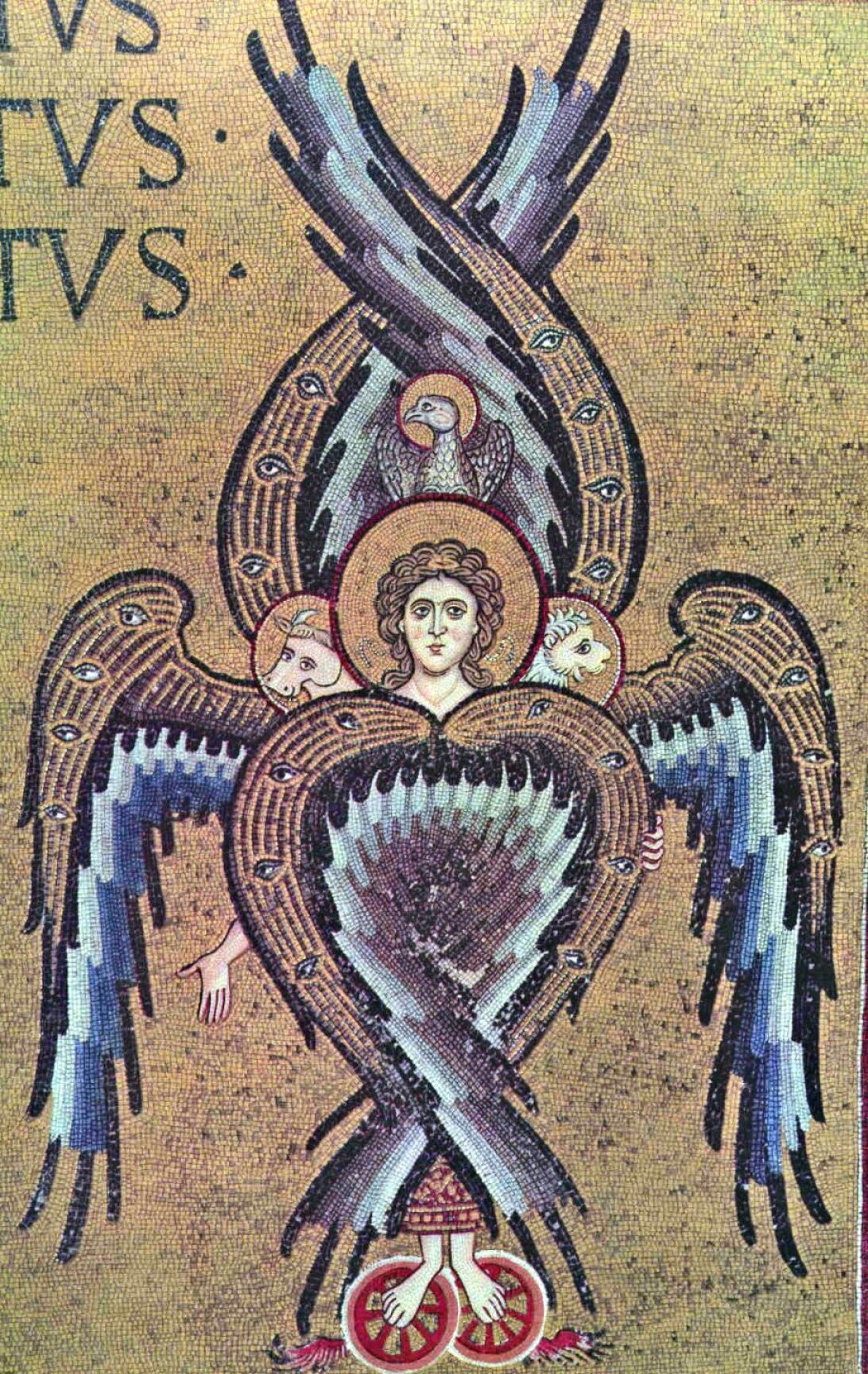
Angelic figures – 4 Heads and 4 wings
They follow the Will of God
The bible describes them in Ezekial 1:5 onwards as:
Also out of the midst thereof came the likeness of four living creatures. And this was their appearance; they had the likeness of a man. 6 And every one had four faces, and every one had four wings. 7 And their feet were straight feet; and the sole of their feet was like the sole of a calf’s foot: and they sparkled like the colour of burnished brass. 8 And they had the hands of a man under their wings on their four sides; and they four had their faces and their wings. 9 Their wings were joined one to another; they turned not when they went; they went every one straight forward. 10 As for the likeness of their faces, they four had the face of a man, and the face of a lion, on the right side: and they four had the face of an ox on the left side; they four also had the face of an eagle. 11 Thus were their faces: and their wings were stretched upward; two wings of every one were joined one to another, and two covered their bodies.
See Remphan, Rephan and Moloch, Molech
[*Easton*]Chiun
CHIUN (2)
ki’-un (Am 5:26 the King James Version): Called in Ac 7:43 “Rephan” (Rhemphan) the planet Saturn.
See ASTROLOGY.
CHIUN (1)
ki’-un: Thus Hebrew kiyun, is transliterated in Am 5:26 the King James Version. The vowels represent an assimilation to some such word as shiqquts, “detestable thing,” or gillul, “idol” (properly “a filthy thing”), in consonance with the well-known habit of the punctuators (compare molekh, Molech with the vowels of bosheth, “shame”). The Syriac version has preserved the correct vocalization; apparently also the Septuagint, albeit the consonants have suffered corruption (so particularly in the Greek manuscripts of Ac 7:43). There can be no doubt that we should vocalize kewan = the Assyrian Kai(a)-wanu = Kaiamanu by which at least in late Babylonian Saturn was indicated. The passage in Amos refers to the Saturn worship which appears to have been in vogue in the prophet’s days. The Israelites shall carry with them into exile the images of their gods (render with the margin of the Revised Version (British and American): “Yea, ye shall take up,” etc.). The received vocalization is as old as Aquila and Symmachus. Max L. Margolis
[*Smith*](a statue , perhaps of Saturn), an idol made by the Israelites in the wilderness. [REMPHAN]The Body of Christ and He is the Head of it. None other.
The body of believers on earth. The New Israel (See Israel)
A group of people gathered to worship the Lord. Representing the Body of Christ on Earth.
When people gather in the name of Christ; He said that He would be present among them (Matt 18:20)
*Only the first 3 links work, rest to be added*
Beloved, the eighth and youngest son of Jesse, a citizen of Bethlehem. His father seems to have been a man in humble life. His mother’s name is not recorded. Some think she was the Nahash of 2 Sam. 17:25. As to his personal appearance, we only know that he was red-haired, with beautiful eyes and a fair face (1 Sam. 16:12; & 1 Sam. 17:42).
His early occupation was that of tending his father’s sheep on the uplands of Judah. From what we know of his after history, doubtless he frequently beguiled his time, when thus engaged, with his shepherd’s flute, while he drank in the many lessons taught him by the varied scenes spread around him. His first recorded exploits were his encounters with the wild beasts of the field. He mentions that with his own unaided hand he slew a lion and also a bear, when they came out against his flock, beating them to death in open conflict with his club (1 Sam. 17:34, 35)
While David, in the freshness of ruddy youth, was thus engaged with his flocks, Samuel paid an unexpected visit to Bethlehem, having been guided thither by divine direction (1 Sam. 16:1-13). There he offered up sacrifice, and called the elders of Israel and Jesse’s family to the sacrificial meal. Among all who appeared before him he failed to discover the one he sought. David was sent for, and the prophet immediately recognized him as the chosen of God, chosen to succeed Saul, who was now departing from the ways of God, on the throne of the kingdom. He accordingly, in anticipation, poured on his head the anointing oil. David went back again to his shepherd life, but “the Spirit of the Lord came upon David from that day forward,” and “the Spirit of the Lord departed from Saul” (1 Sam. 16:13, 14).
Not long after this David was sent for to soothe with his harp the troubled spirit of Saul, who suffered from a strange melancholy dejection. He played before the king so skilfully that Saul was greatly cheered, and began to entertain great affection for the young shepherd. After this he went home to Bethlehem. But he soon again came into prominence. The armies of the Philistines and of Israel were in battle array in the valley of Elah, some 16 miles south-west of Bethlehem; and David was sent by his father with provisions for his three brothers, who were then fighting on the side of the king. On his arrival in the camp of Israel, David (now about twenty years of age) was made aware of the state of matters when the champion of the Philistines, Goliath of Gath, came forth to defy Israel. David took his sling, and with a well-trained aim threw a stone “out of the brook,” which struck the giant’s forehead, so that he fell senseless to the ground. David then ran and slew him, and cut off his head with his own sword (1 Sam. 17). The result was a great victory to the Israelites, who pursued the Philistines to the gates of Gath and Ekron.
David’s popularity consequent on this heroic exploit awakened Saul’s jealousy (1 Sam. 18:6-16), which he showed in various ways. He conceived a bitter hatred toward him, and by various stratagems sought his death (1 Sam. 18-30). The deep-laid plots of the enraged king, who could not fail to observe that David “prospered exceedingly,” all proved futile, and only endeared the young hero the more to the people, and very specially to Jonathan, Saul’s son, between whom and David a life-long warm friendship was formed.
A fugitive. To escape from the vengeance of Saul, David fled to Ramah (1 Sam. 19:12-18) to Samuel, who received him, and he dwelt among the sons of the prophets, who were there under Samuel’s training. It is supposed by some that the sixth, seventh, and eleventh Psalms were composed by him at this time. This place was only 3 miles from the residence of Saul, who soon discovered whither the fugitive had gone, and tried ineffectually to bring him back. Jonathan made a fruitless effort to bring his father to a better state of mind toward David (1 Sam. 20), who, being made aware of the fact, saw no hope of safety but in flight to a distance. We accordingly find him first at Nob (21:1-9) and then at Gath, the chief city of the Philistines. The king of the Philistines would not admit him into his service, as he expected that he would, and David accordingly now betook himself to the stronghold of Adullam (22:1-4; 1 Chr. 12:8-18). Here in a short time 400 men gathered around him and acknowledged him as their leader. It was at this time that David, amid the harassment and perils of his position, cried, “Oh that one would give me drink of the water of the well of Bethlehem;” when three of his heroes broke through the lines of the Philistines and brought him the water for which he longed (2 Sam. 23:13-17), but which he would not drink.
In his rage at the failure of all his efforts to seize David, Saul gave orders for the massacre of the entire priestly family at Nob, “persons who wore a linen ephod”, to the number of eighty-five persons, who were put to death by Doeg the Edomite. The sad tidings of the massacre were brought to David by Abiathar, a son of Ahimelech, the only one who escaped. Comp. Ps. 52.
Hearing that Keilah, a town on the western frontier, was harassed by the Philistines, David with his men relieved it (1 Sam. 23:1-14); and then, for fear of Saul, he fled to the strongholds in the “hill country” of Judah. Comp. Ps. 31. While encamped there, in the forest in the district of Ziph, he was visited by Jonathan, who spoke to him words of encouragement (23:16-18). The two now parted never to meet again. Saul continued his pursuit of David, who narrowly escaped from him at this time, and fled to the crags and ravines of Engedi, on the western shore of the Dead Sea (1 Sam. 23:29). Here Saul, who still pursued him with his army, narrowly escaped, through the generous forbearance of David, and was greatly affected by what David had done for him. He returned home from pursuing him, and David betook himself to Maon, where, with his 600 men, he maintained himself by contributions gathered from the district. Here occurred the incident connected with Nabal and his wife Abigail (1 Sam. 25), whom David married after Nabal’s death.
Saul again went forth (1 Sam. 26) in pursuit of David, who had hid himself “in the hill Hachilah, which is before Jeshimon,” in the wilderness of Ziph, and was a second time spared through his forbearance. He returned home, professing shame and penitence for the way in which he had treated David, and predicting his elevation to the throne.
Fighting against Israel. Harassed by the necessity of moving from place to place through fear of Saul, David once more sought refuge among the Philistines (1 Sam. 27). He was welcomed by the king, who assigned him Ziklag as his residence. Here David lived among his followers for some time as an independent chief engaged in frequent war with the Amalekites and other tribes on the south of Judah.
Achish summoned David with his men to join his army against Saul; but the lords of the Philistines were suspicious of David’s loyalty, and therefore he was sent back to Ziklag, which he found to his dismay may had been pillaged and burnt during his brief absence. David pursued after the raiders, the Amalekites, and completely routed them. On his return to Ziklag tidings reached him of Saul’s death (2 Sam. 1). An Amalekite brought Saul’s crown and bracelet and laid them at his feet. David and his men rent their clothes and mourned for Saul, who had been defeated in battle near Mount Gilboa. David composed a beautiful elegy, the most beautiful of all extant Hebrew odes, a “lamentation over Saul and over Jonathan his son” (2 Sam. 1:18-27). It bore the title of “The Bow,” and was to be taught to the children, that the memory of Saul and Jonathan might be preserved among them. “Behold, it is written in the book of Jasher” (q.v.).
David king over Judah. David and his men now set out for Hebron under divine direction (2 Sam. 2:1-4). There they were cordially welcomed, and he was at once anointed as king. He was now about thirty years of age.
But his title to the throne was not undisputed. Abner took Ish-bosheth, Saul’s only remaining son, over the Jordan to Mahanaim, and there crowned him as king. Then began a civil war in Israel. The first encounter between the two opposing armies, led on the one side by Abner, and on the other by Joab, took place at the pool of Gibeon. It resulted in the defeat of Abner. Other encounters, however, between Israel and Judah followed (2 Sam. 3:1, 5), but still success was on the side of David. For the space of seven and a half years David reigned in Hebron. Abner now sided with David, and sought to promote his advancement; but was treacherously put to death by Joab in revenge for his having slain his brother Asahel at Gibeon (3:22-39). This was greatly to David’s regret. He mourned for the death of Abner. Shortly after this Ish-bosheth was also treacherously put to death by two Canaanites of Beeroth; and there being now no rival, David was anointed king over all Israel (4:1-12).
David king over all Israel (2 Sam. 5:1-5; 1 Chr. 11:1-3). The elders of Israel now repaired to Hebron and offered allegiance to David in name of all the people, among whom the greatest enthusiasm prevailed. He was anointed king over all Israel, and sought out a new seat of government, more suitable than Hebron, as the capital of his empire. At this time there was a Jebusite fortress, “the stronghold”, on the hill of Zion, called also Jebus. This David took from the Jebusites, and made it Israel’s capital, and established here his residence, and afterwards built for himself a palace by the aid of Tyrian tradesmen. The Philistines, who had for some time observed a kind of truce, now made war against David; but were defeated in battle at a place afterwards called, in remembrance of the victory, Baal-perazim. Again they invaded the land, and were a second time routed by him. He thus delivered Israel from their enemies.
David now resolved to bring up the ark of the covenant to his new capital (2 Sam. 6). It was in the house of Abinadab at Kirjath-jearim, about 7 miles from Jerusalem, where it had been for many years, from the time when the Philistines had sent it home (1 Sam. 6; 7). In consequence of the death of Uzzah (for it was a divine ordinance that only the Levites should handle the ark, Num. 4), who had put forth his hand to steady the ark when the cart in which it was being conveyed shook by reason of the roughness of the road, David stayed the procession, and conveyed the ark into the house of Obed-edom, a Philistine from Gath. After three months David brought the ark from the house of Obed-edom up to Jerusalem. Comp. Ps. 24. Here it was placed in a new tent or tabernacle which David erected for the purpose. About seventy years had passed since it had stood in the tabernacle at Shiloh. The old tabernacle was now at Gibeah, at which Zadok ministered. David now (1 Chr. 16) carefully set in order all the ritual of divine worship at Jerusalem, along with Abiathar the high priest. A new religious era began. The service of praise was for the first time introduced into public worship. Zion became henceforth “God’s holy hill.”
David’s wars. David now entered on a series of conquests which greatly extended and strengthened his kingdom (2 Sam. 8). In a few years the whole territory from the Euphrates to the river of Egypt, and from Gaza on the west to Thapsacus on the east, was under his sway (2 Sam. 8:3-13; 10).
David’s fall. He had now reached the height of his glory. He ruled over a vast empire, and his capital was enriched with the spoils of many lands. But in the midst of all this success he fell, and his character became stained with the sin of adultery (2 Sam. 11:2-27). It has been noted as characteristic of the Bible that while his military triumphs are recorded in a few verses, the sad story of his fall is given in detail, a story full of warning, and therefore recorded. This crime, in the attempt to conceal it, led to anoter. He was guilty of murder. Uriah, whom he had foully wronged, an officer of the Gibborim, the corps of heros (23:39), was, by his order, “set in the front of the hottest battle” at the siege of Rabbah, in order that he might be put to death. Nathan the prophet (2 Sam. 7:1-17; 12:1-23) was sent by God to bring home his crimes to the conscience of the guilty monarch. He became a true penitent. He bitterly bewailed his sins before God. The thirty-second and fifty-first Psalms reveal the deep struggles of his soul, and his spiritual recovery.
Bathsheba became his wife after Uriah’s death. Her first-born son died, according to the word of the prophet. She gave birth to a second son, whom David called Solomon, and who ultimately succeeded him on the throne (2 Sam. 12:24, 25).
Peace. After the successful termination of all his wars, David formed the idea of building a temple for the ark of God. This he was not permitted to carry into execution, because he had been a man of war. God, however, sent Nathan to him with a gracious message (2 Sam. 7:1-16). On receiving it he went into the sanctuary, the tent where the ark was, and sat before the Lord, and poured out his heart in words of devout thanksgiving (18-29). The building of the temple was reserved for his son Solomon, who would be a man of peace (1 Chr. 22:9; 28:3).
A cloudy evening. Hitherto David’s carrer had been one of great prosperity and success. Now cloudy and dark days came. His eldest son Amnon, whose mother was Ahinoam of Jezreel, was guilty of a great and shameful crime (2 Sam. 13). This was the beginning of the disasters of his later years. After two years Absalom terribly avenged the crime against Tamar, and put Amnon to death. This brought sore trouble to David’s heart. Absalom, afraid of the consequences of his guilt, fled to Geshur beyond Jordan, where he remained for three years, when he was brought back through the intrigue of Joab (2 Sam. 14).
After this there fell upon the land the calamity of three years’ famine (2 Sam. 21:1-14). This was soon after followed by a pestilence, brought upon the land as a punishment for David’s sinful pride in numbering the people (2 Sam. 24), in which no fewer than 70,000 perished in the space of three days.
Rebellion of Absalom. The personal respect for David was sadly lowered by the incident of Bathsheba. There was a strong popular sentiment against the taking of the census, and the outburst of the plague in connection with it deepened the feeling of jealously that had begun to manifest itself among some of the tribes against David. Absalom, taking full advantage of this state of things, gradually gained over the people, and at length openly rebelled against his father, and usurped the throne. Ahithophel was Absalom’s chief counsellor. The revolt began in Hebron, the capital of Judah. Absalom was there proclaimed king. David was now in imminent danger, and he left Jerusalem (2 Sam. 15:13-20), and once more became a fugitive. It was a momentous day in Israel. The incidents of it are recorded with a fulness of detail greater than of any other day in Old Testament history. David fled with his followers to Mahanarm, on the east of Jordan. An unnatural civil war broke out. After a few weeks the rival armies were mustered and organized. They met in hostile array at the wood of Ephraim (2 Sam. 18:1-8). Absalom’s army was defeated, and himself put to death by the hand of Joab (9-18). The tidings of the death of his rebellious son filled the heart of David with the most poignant grief. He “went up to the chamber over the gate, and wept” (33), giving utterance to the heart-broken cry, “Would God I had died for thee, O Absalom, my son, my son!” Peace was now restored, and David returned to Jerusalem and resumed the direction of affairs. An unhappy dispute arose between the men of Judah and the men of Israel (19:41-43). Sheba, a Benjamite, headed a revolt of the men of Israel. He was pursued to Abelbeth-maachah, and was there put to death, and so the revolt came to an end.
The end. After the suppression of the rebellion of Absalom and that of Sheba, ten comparatively peaceful years of David’s life passed away. During those years he seems to have been principally engaged in accumulating treasures of every kind for the great temple at Jerusalem, which it was reserved to his successor to build (1 Chr. 22; 28; 29), a house which was to be “exceeding magnifical, of fame and of glory throughout all countries” (22:5). The exciting and laborious life he had spent, and the dangers and trials through which he had passed, had left him an enfeebled man, prematurely old. It became apparent that his life was now drawing to its close. A new palace conspiracy broke out as to who should be his successor. Joab favoured Adonijah. The chiefs of his party met at the “Fuller’s spring,” in the valley of Kidron, to proclaim him king; but Nathan hastened on a decision on the part of David in favour of Solomon, and so the aim of Adonijah’s party failed. Solomon was brought to Jerusalem, and was anointed king and seated on his father’s throne (1 Kings 1:11-53). David’s last words are a grand utterance, revealing his unfailing faith in God, and his joyful confidence in his gracious covenant promises (2 Sam. 23:1-7).
After a reign of forty years and six months (2 Sam. 5:5; 1 Chr. 3:4) David died (B.C. 1015) at the age of seventy years, “and was buried in the city of David.” His tomb is still pointed out on Mount Zion.
Both in his prophetical and in his regal character David was a type of the Messiah (1 Sam. 16:13). The book of Psalms commonly bears the title of the “Psalms of David,” from the circumstance that he was the largest contributor (about eighty psalms) to the collection. (See PSALMS.)
“The greatness of David was felt when he was gone. He had lived in harmony with both the priesthood and the prophets; a sure sign that the spirit of his government had been throughly loyal to the higher aims of the theocracy. The nation had not been oppressed by him, but had been left in the free enjoyment of its ancient liberties. As far as his power went he had striven to act justly to all (2 Sam. 8:15). His weak indulgence to his sons, and his own great sin besides, had been bitterly atoned, and were forgotten at his death in the remembrance of his long-tried worth. He had reigned thirty-three years in Jerusalem and seven and a half at Hebron (2 Sam. 5:5). Israel at his accession had reached the lowest point of national depression; its new-born unity rudely dissolved; its territory assailed by the Philistines. But he had left it an imperial power, with dominions like those of Egypt or Assyria. The sceptre of Solomon was already, before his father’s death, owned from the Mediterranean to the Euphrates, and from the Orontes to the Red Sea.”, Geikie’s Hours etc., iii.
Easton’s Bible Dictionary
*Jacob’s older brother. Sold his birthright to Jacob over pottage of lentils*
Hairy, Rebekah’s first-born twin son (Gen. 25:25). The name of Edom, “red”, was also given to him from his conduct in connection with the red lentil “pottage” for which he sold his birthright (30, 31). The circumstances connected with his birth foreshadowed the enmity which afterwards subsisted between the twin brothers and the nations they founded (25:22, 23, 26). In process of time Jacob, following his natural bent, became a shepherd; while Esau, a “son of the desert,” devoted himself to the perilous and toilsome life of a huntsman. On a
certain occasion, on returning from the chase, urged by the cravings of hunger, Esau sold his birthright to his brother, Jacob, who thereby obtained the covenant blessing (Gen. 27:28, 29, 36; Heb.12:16, 17). He afterwards tried to regain what he had so recklessly parted with, but was defeated in his attempts through the stealth of his brother (Gen. 27:4, 34, 38).
At the age of forty years, to the great grief of his parents, he married (Gen. 26:34, 35) two Canaanitish maidens, Judith, the daughter of Beeri, and Bashemath, the daughter of Elon. When Jacob was sent away to Padan-aram, Esau tried to conciliate his parents (Gen. 28:8, 9) by marrying his cousin Mahalath, the daughter of Ishmael. This led him to cast in his lot with the Ishmaelite tribes; and driving the Horites out of Mount Seir, he settled in that region. After some thirty years’ sojourn in Padan-aram Jacob returned to Canaan, and was reconciled to Esau, who went forth to meet him (33:4). Twenty years after this, Isaac their father died, when the two brothers met, probably for the last time, beside his grave (35:29). Esau now
permanently left Canaan, and established himself as a powerful and wealthy chief in the land of Edom (q.v.).
Long after this, when the descendants of Jacob came out of Egypt, the Edomites remembered the old quarrel between the brothers, and with fierce hatred they warred against Israel.
Easton’s Bible Dictionary
The name the first Christians gave to themselves
Eternal home and Throne of God.
The Promise
The faithful chosen saved by the grace of Jesus will inherit it, and the reward is to be in eternal Presence of our Father.
Revelation 21:3-6
And I heard a great voice out of heaven saying, Behold, the tabernacle of God is with men, and he will dwell with them, and they shall be his people, and God himself shall be with them, and be their God.
4 And God shall wipe away all tears from their eyes; and there shall be no more death, neither sorrow, nor crying, neither shall there be any more pain: for the former things are passed away.
5 And he that sat upon the throne said, Behold, I make all things new. And he said unto me, Write: for these words are true and faithful.
6 And he said unto me, It is done. I am Alpha and Omega, the beginning and the end. I will give unto him that is athirst of the fountain of the water of life freely.
We will have incorruptible bodies, and there will be no more pain in all its kinds.
Acronym of the Latin phrase:
IESVS·NAZARENVS·REX·IVDÆORVM
or
Jesus Nazarenus Rex Judæorum
English:
Jesus Nazarene King of the Jews
This is a Titulus Crucis or Title of the Cross for Jesus Christ. A Sign Inscribed in wood and placed at the top of the cross, above Christ’s head.
The Title on Christ’s cross, was written in Latin Greek and Hebrew
Verses this was mentioned:
Matthew 27:37-38
And set up over his head his accusation written, THIS IS JESUS THE KING OF THE JEWS. 38 Then were there two thieves crucified with him, one on the right hand, and another on the left.
Mark 15:25-27
And it was the third hour, and they crucified him. 26 And the superscription of his accusation was written over, THE KING OF THE JEWS. 27 And with him they crucify two thieves; the one on his right hand, and the other on his left.
Luke 23:38-39
And a superscription also was written over him in letters of Greek, and Latin, and Hebrew, THIS IS THE KING OF THE JEWS. 39 And one of the malefactors which were hanged railed on him, saying, If thou be Christ, save thyself and us.
John 19:19-21
And Pilate wrote a title, and put it on the cross. And the writing was, JESUS OF NAZARETH THE KING OF THE JEWS. 20 This title then read many of the Jews: for the place where Jesus was crucified was nigh to the city: and it was written in Hebrew, and Greek, and Latin. 21 Then said the chief priests of the Jews to Pilate, Write not, The King of the Jews; but that he said, I am King of the Jews.
Isaac means laughter
The boy Abraham was supposed to sacrifice as an act of faith to God.
(1) Israel, or the kingdom of the ten tribes (Amos 7:9, 16).
(2.) The only son of Abraham by Sarah. He was the longest lived of the three patriarchs (Gen. 21:1-3). He was circumcised when eight days old (4-7); and when he was probably two years old a great feast was held in connection with his being weaned.
The next memorable event in his life is that connected with the command of God given to Abraham to offer him up as a sacrifice on a mountain in the land of Moriah (Gen. 22). (See ABRAHAM.) When he was forty years of age Rebekah was chosen for his wife (Gen. 24). After the death and burial of his father he took up his residence at Beer-lahai-roi (25:7-11), where his two sons, Esau and Jacob, were born (21-26), the former of whom seems to have been his favourite son (27,28).
In consequence of a famine (Gen. 26:1) Isaac went to Gerar, where he practised deception as to his relation to Rebekah, imitating the conduct of his father in Egypt (12:12-20) and in Gerar (20:2). The Philistine king rebuked him for his prevarication.
After sojourning for some time in the land of the Philistines, he returned to Beersheba, where God gave him fresh assurance of covenant blessing, and where Abimelech entered into a covenant of peace with him.
The next chief event in his life was the blessing of his sons (Gen. 27:1). He died at Mamre, “being old and full of days” (35:27-29), one hundred and eighty years old, and was buried in the cave of Machpelah.
In the New Testament reference is made to his having been “offered up” by his father (Heb. 11:17; James 2:21), and to his blessing his sons (Heb. 11:20). As the child of promise, he is contrasted with Ishmael (Rom. 9:7, 10; Gal. 4:28; Heb. 11:18).
Isaac is “at once a counterpart of his father in simple devoutness and purity of life, and a contrast in his passive weakness of character, which in part, at least, may have sprung from his relations to his mother and wife. After the expulsion of Ishmael and Hagar, Isaac had no competitor, and grew up in the shade of Sarah’s tent, moulded into feminine softness by habitual submission to her strong, loving will.” His life was so quiet and uneventful that it was spent “within the circle of a few miles; so guileless that he let Jacob overreach him rather than disbelieve his assurance; so tender that his mother’s death was the poignant sorrow of years; so patient and gentle that peace with his neighbours was dearer than even such a coveted possession as a well of living water dug by his own men; so grandly obedient that he put his life at his father’s disposal; so firm in his reliance on God that his greatest concern through life was to honour the divine promise given to his race.”, Geikie’s Hours, etc.
Easton’s Bible Dictionary
————————————-
The son whom Sara bore to Abraham, in the hundredth year of his age, at Gerar. (B.C. 1897.) In his infancy he became the object of Ishmael’s jealousy; and in his youth the victim, in intention, of Abraham’s great sacrificial act of faith. When forty years old he married Rebekah his cousin, by whom, when he was sixty, he had two sons, Esau and Jacob. Driven by famine to Gerar, he acquired great wealth by his flocks but was repeatedly dispossessed by the Philistines of the wells which he sunk at convenient stations. After the deceit by which Jacob acquired his father’s blessing Isaac sent his son to seek a wife in Padan-aram; and all that we know of him during the last forty-three years of his life in that he saw that GOD, with a large and prosperous family, return to him at Hebron. (Genesis 36:27) before he died there, at the age of 180 years. He was buried by his two sons in the cave of Machpelah. In the New Testament reference is made to the offering of Isaac (Hebrews 11:17; James 2:21) and to his blessing his sons. (Hebrews 11:20) In (Galatians 4:28-31) he is contrasted with Ishmael. In reference to the offering up of Isaac by Abraham, the primary doctrine taught are those of sacrifice and substitution, as the means appointed by God for taking away sin; and, as co-ordinate with these, the need of the obedience of faith, on the part of man, to receive the benefit. (Hebrews 11:17) The animal which God provided and Abraham offered was in the whole history of sacrifice the recognized type of “the Lamb of God, that taketh away the sins of the world.” Isaac is the type of humanity itself, devoted to death for sin. (Smith’s Bible Dictionary)
Israel (Today)
According to The Word of God
The Church – All the faithful in Christ – The Body of Christ
Romans 9-6
Not as though the word of God hath taken none effect. For they are not all Israel, which are of Israel: 7 Neither, because they are the seed of Abraham, are they all children: but, In Isaac shall thy seed be called. 8 That is, They which are the children of the flesh, these are not the children of God: but the children of the promise are counted for the seed.
Galatians 3:21-29
Is the law then against the promises of God? God forbid: for if there had been a law given which could have given life, verily righteousness should have been by the law. 22 But the scripture hath concluded all under sin, that the promise by faith of Jesus Christ might be given to them that believe. 23 But before faith came, we were kept under the law, shut up unto the faith which should afterwards be revealed. 24 Wherefore the law was our schoolmaster to bring us unto Christ, that we might be justified by faith. 25 But after that faith is come, we are no longer under a schoolmaster. 26 For ye are all the children of God by faith in Christ Jesus. 27 For as many of you as have been baptized into Christ have put on Christ. 28 There is neither Jew nor Greek, there is neither bond nor free, there is neither male nor female: for ye are all one in Christ Jesus. 29 And if ye be Christ’s, then are ye Abraham’s seed, and heirs according to the promise.
Israel (Initial Use)
The name conferred on Jacob after the great prayer-struggle at Peniel (Gen. 32:28), because “as a prince he had power with God and prevailed.” (See JACOB.) This is the common name given to Jacob’s descendants. The whole people of the twelve tribes are called “Israelites,” the “children of Israel” (Josh. 3:17; 7:25; Judg. 8:27; Jer. 3:21), and the “house of Israel” (Ex. 16:31; 40:38).
This name Israel is sometimes used emphatically for the true Israel (Ps. 73:1: Isa. 45:17; 49:3; John 1:47; Rom. 9:6; 11:26).
After the death of Saul the ten tribes arrogated to themselves this name, as if they were the whole nation (2 Sam. 2:9, 10, 17, 28; 3:10, 17; 19:40-43), and the kings of the ten tribes were called “kings of Israel,” while the kings of the two tribes were called “kings of Judah.”
After the Exile the name Israel was assumed as designating the entire nation.
Easton’s Bible Dictionary
Summary:
Esau sold his birthright to Jacob for some pottage. He was hungry after coming back from a unsuccessful hunt (Genesis 25:28-34)
Jacob wrestled with Jesus all night to get His blessing. Jesus gave it to him. Jacob said in Genesis 32:30 “… for I have seen God face to face, and my life is preserved” Jesus makes God the Father known. See John 1:18
Official Definition
One who follows on another’s heels; supplanter, (Gen. 25:26; 27:36; Hos. 12:2-4), the second born of the twin sons of Isaac by Rebekah. He was born probably at Lahai-roi, when his father was fifty-nine and Abraham one hundred and fifty-nine years old. Like his father, he was of a quiet and gentle disposition, and when he grew up followed the life of a shepherd, while his brother Esau became an enterprising hunter. His dealing with Esau, however, showed much mean selfishness and cunning (Gen. 25:29-34).
When Isaac was about 160 years of age, Jacob and his mother conspired to deceive the aged patriarch (Gen. 27), with the view of procuring the transfer of the birthright to himself. The birthright secured to him who possessed it (1) superior rank in his family (Gen. 49:3); (2) a double portion of the paternal inheritance (Deut. 21:17); (3) the priestly office in the family (Num. 8:17-19); and (4) the promise of the Seed in which all nations of the earth were to be blessed (Gen. 22:18).
Soon after his acquisition of his father’s blessing (Gen. 27), Jacob became conscious of his guilt; and afraid of the anger of Esau, at the suggestion of Rebekah Isaac sent him away to Haran, 400 miles or more, to find a wife among his cousins, the family of Laban, the Syrian (28). There he met with Rachel (29). Laban would not consent to give him his daughter in marriage till he had served seven years; but to Jacob these years “seemed but a few days, for the love he had to her.” But when the seven years were expired, Laban craftily deceived Jacob, and gave him his daughter Leah. Other seven years of service had to be completed probably before he obtained the beloved Rachel. But “life-long sorrow, disgrace, and trials, in the retributive providence of God, followed as a consequence of this double union.”
At the close of the fourteen years of service, Jacob desired to return to his parents, but at the entreaty of Laban he tarried yet six years with him, tending his flocks (31:41). He then set out with his family and property “to go to Isaac his father in the land of Canaan” (Gen. 31). Laban was angry when he heard that Jacob had set out on his journey, and pursued after him, overtaking him in seven days. The meeting was of a painful kind. After much recrimination and reproach directed against Jacob, Laban is at length pacified, and taking an affectionate farewell of his daughters, returns to his home in Padanaram. And now all connection of the Israelites with Mesopotamia is at an end.
Soon after parting with Laban he is met by a company of angels, as if to greet him on his return and welcome him back to the Land of Promise (32:1, 2). He called the name of the place Mahanaim, i.e., “the double camp,” probably his own camp and that of the angels. The vision of angels was the counterpart of that he had formerly seen at Bethel, when, twenty years before, the weary, solitary traveller, on his way to Padan-aram, saw the angels of God ascending and descending on the ladder whose top reached to heaven (28:12).
He now hears with dismay of the approach of his brother Esau with a band of 400 men to meet him. In great agony of mind he prepares for the worst. He feels that he must now depend only on God, and he betakes himself to him in earnest prayer, and sends on before him a munificent present to Esau, “a present to my lord Esau from thy servant Jacob.” Jacob’s family were then transported across the Jabbok; but he himself remained behind, spending the night in communion with God. While thus engaged, there appeared one in the form of a man who wrestled with him. In this mysterious contest Jacob prevailed, and as a memorial of it his name was changed to Israel (wrestler with God); and the place where this occured he called Peniel, “for”, said he, “I have seen God face to face, and my life is preserved” (32:25-31).
After this anxious night, Jacob went on his way, halting, mysteriously weakened by the conflict, but strong in the assurance of the divine favour. Esau came forth and met him; but his spirit of revenge was appeased, and the brothers met as friends, and during the remainder of their lives they maintained friendly relations. After a brief sojourn at Succoth, Jacob moved forward and pitched his tent near Shechem (q.v.), 33:18; but at length, under divine directions, he moved to Bethel, where he made an altar unto God (35:6,7), and where God appeared to him and renewed the Abrahamic covenant. While journeying from Bethel to Ephrath (the Canaanitish name of Bethlehem), Rachel died in giving birth to her second son Benjamin (35:16-20), fifteen or sixteen years after the birth of Joseph. He then reached the old family residence at Mamre, to wait on the dying bed of his father Isaac. The complete reconciliation between Esau and Jacob was shown by their uniting in the burial of the patriarch (35:27-29).
Jacob was soon after this deeply grieved by the loss of his beloved son Joseph through the jealousy of his brothers (37:33). Then follows the story of the famine, and the successive goings down into Egypt to buy corn (42), which led to the discovery of the long-lost Joseph, and the patriarch’s going down with all his household, numbering about seventy souls (Ex. 1:5; Deut. 10:22; Acts 7:14), to sojourn in the land of Goshen. Here Jacob, “after being strangely tossed about on a very rough ocean, found at last a tranquil harbour, where all the best affections of his nature were gently exercised and largely unfolded” (Gen. 48). At length the end of his checkered course draws nigh, and he summons his sons to his bedside that he may bless them. Among his last words he repeats the story of Rachel’s death, although forty years had passed away since that event took place, as tenderly as if it had happened only yesterday; and when “he had made an end of charging his sons, he gathered up his feet into the bed, and yielded up the ghost” (49:33). His body was embalmed and carried with great pomp into the land of Canaan, and buried beside his wife Leah in the cave of Machpelah, according to his dying charge. There, probably, his embalmed body remains to this day (50:1-13). (See HEBRON.)
The history of Jacob is referred to by the prophets Hosea (12:3, 4, 12) and Malachi (1:2). In Micah 1:5 the name is a poetic synonym for Israel, the kingdom of the ten tribes. There are, besides the mention of his name along with those of the other patriarchs, distinct references to events of his life in Paul’s epistles (Rom. 9:11-13; Heb. 12:16; 11:21). See references to his vision at Bethel and his possession of land at Shechem in John 1:51; 4:5, 12; also to the famine which was the occasion of his going down into Egypt in Acts 7:12 (See LUZ; BETHEL.)
Easton’s Bible Dictionary
Yahweh is gracious
God is gracious
John is also known as Marcus
John Marc
Polite; Shining
Marcus is also known as John
John Marc
A Union between a male and female, the joining of 2 bodies to become one. Where man is the head and the woman is the Body. They must work as one, care for and love one another. The man is expected to give his life for his family “Just as Christ loved the Church” (Eph 5:25)
Ultimately it is about perpetuating life, taking on the image of our Father and fulfilling His commandment of being fruitful and multiply.
It also happens to be the healthiest and most stable structure humanity has ever known. It is a blessing indeed
Genesis 1:28
And God blessed them, and God said unto them, Be fruitful, and multiply, and replenish the earth, and subdue it: and have dominion over the fish of the sea, and over the fowl of the air, and over every living thing that moveth upon the earth.
Genesis 5:1-2
This is the book of the generations of Adam. In the day that God created man, in the likeness of God made he him;
2 Male and female created he them; and blessed them, and called their name Adam, in the day when they were created.
Mark 10:6-9
But from the beginning of the creation God made them male and female.
7 For this cause shall a man leave his father and mother, and cleave to his wife;
8 And they twain shall be one flesh: so then they are no more twain, but one flesh.
9 What therefore God hath joined together, let not man put asunder.
See Remphan, Rephan and Chiun
god of the children of Ammon
Canaanite god. God of the Phoenecians
Also known as Baal
[*ISBE*]NEPHILIM
See Remphan, Chiun, Molech
[*Hitchcock*]Prepared; Arrayed[*ISBE*]re’-fan: A name for Chiun, the planet Saturn.
First Nazarite (from Nazareth) mentioned in Scripture
[*ISBE*]SAMSONTransgression of the law of God. Committing an Evil act.
Rebellion against God
Punishable by death. “The wages of sin is death” Romans 6:23
Fact of this fallen world.
Remnant of the effect of the disobedience of Adam and Eve. God’s plan is to return us to our original form and away from our sinful nature. Jesus is the Way.
So for sin to be paid off; blood must be shed.
The example of Adam and Even after eating from the forbidden tree. For their sin, God used animal skins to cover their nakedness.
Abraham and Isaac, God provided the ram instead of Abraham’s only son. This was a precursor to Jesus Christ.
Finally Jesus Christ: The Blameless Lamb of God which was offered as a sacrifice one for all. Jesus was The One which Fulfilled the Law
Elevated. (1.) Denotes Mount Hermon in Deut. 4:48; called Sirion by the Sidonians, and by the Amorites Shenir (Deut. 3:9). (See HERMON.) (2.) The Greek form of Zion (q.v.) in Matt. 21:5; John 12:15.
Easton’s Bible Dictionary
Sunny; height, one of the eminences on which Jerusalem was built. It was surrounded on all sides, except the north, by deep valleys, that of the Tyropoeon (q.v.) separating it from Moriah (q.v.), which it surpasses in height by 105 feet. It was the south-eastern hill of Jerusalem. When David took it from the Jebusites (Josh. 15:63; 2 Sam. 5:7) he built on it a citadel and a palace, and it became “the city of David” (1 Kings 8:1; 2 Kings 19:21, 31; 1 Chr. 11:5). In the later books of the Old Testament this name was sometimes used (Ps. 87:2; 149:2; Isa. 33:14; Joel 2:1) to denote Jerusalem in general, and sometimes God’s chosen Israel (Ps. 51:18; 87:5). In the New Testament (see SION) it is used sometimes to denote the Church of God (Heb. 12:22), and sometimes the heavenly city (Rev. 14:1).
04 / Nations & Peoples
Nations & Peoples (Incomplete)
Highlanders, or hillmen, the name given to the descendants of one of the sons of Canaan (Gen. 14:7), called Amurra or Amurri in the Assyrian and Egyptian inscriptions. On the early Babylonian monuments all Syria, including Palestine, is known as “the land of the Amorites.” The southern slopes of the mountains of Judea are called the “mount of the Amorites” (Deut. 1:7, 19, 20). They seem to have originally occupied the land stretching from the heights west of the Dead Sea (Gen. 14:7) to Hebron (13. Comp. 13:8; Deut. 3:8; 4:46-48), embracing “all Gilead and all Bashan” (Deut. 3:10), with the Jordan valley on the east of the river (4:49), the land of the “two kings of the Amorites,” Sihon and Og (Deut. 31:4; Josh. 2:10; 9:10). The five kings of the Amorites were defeated with great slaughter by Joshua (10:10). They were again defeated at the waters of Merom by Joshua, who smote them till there were none remaining (Josh. 11:8). It is mentioned as a surprising circumstance that in the days of Samuel there was peace between them and the Israelites (1 Sam. 7:14). The discrepancy supposed to exist between Deut. 1:44 and Num. 14:45 is explained by the circumstance that the terms “Amorites” and “Amalekites” are used synonymously for the “Canaanites.” In the same way we explain the fact that the “Hivites” of Gen. 34:2 are the “Amorites” of 48:22. Comp. Josh. 10:6; 11:19 with 2 Sam. 21:2; also Num. 14:45 with Deut. 1:44. The Amorites were warlike mountaineers. They are represented on the Egyptian monuments with fair skins, light hair, blue eyes, aquiline noses, and pointed beards. They are supposed to have been men of great stature; their king, Og, is described by Moses as the last “of the remnant of the giants” (Deut. 3:11). Both Sihon and Og were independent kings. Only one word of the Amorite language survives, “Shenir,” the name they gave to Mount Hermon (Deut. 3:9).
The destroyer, subduer, or fish-god, the god of the Moabites (Num. 21:29; Jer. 48:7, 13, 46). The worship of this god, “the abomination of Moab,” was introduced at Jerusalem by Solomon (1 Kings 11:7), but was abolished by Josiah (2 Kings 23:13). On the “Moabite Stone” (q.v.), Mesha (2 Kings 3:5) ascribes his victories over the king of Israel to this god, “And Chemosh drove him before my sight.”
In this section:
Continue discerning.
Explore God & Science or Evil & The Last Days from the Discerning section.
Loading today's verse…
Emmanuel · God with us
Changes every 4 seconds

Scroll up for older posts
2026–27
Fixed-feast dates use the common civil calendar; Old Calendar communities observe immovable feasts 13 days later.